
After reading this article you can answer this UPSC model question
India’s E20 ethanol blending programme can strengthen energy security, but it also raises concerns related to food security, water use and vehicle compatibility. Critically examine the opportunities and challenges associated with the E20 transition. Suggest measures to ensure a sustainable and inclusive biofuel policy. 15 marks (GS3, Economy)
Context
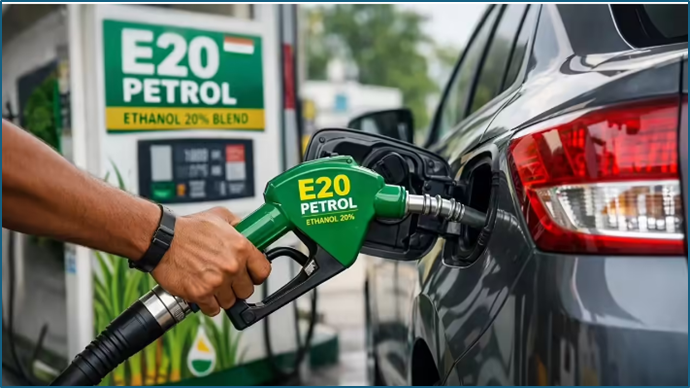
India’s E20 programme, involving 20% ethanol-blended petrol, achieved the blending target in 2025, rising from ~1.5% in 2014. It seeks to strengthen energy security, reduce oil imports, boost farmer incomes and cut emissions, with the government reporting over ₹1.90 lakh crore in forex savings. However, concerns remain over vehicle compatibility, mileage, food–fuel competition, water use and long-term sustainability.
Introduction
- India’s Ethanol Blended Petrol (EBP) Programme aims to reduce crude-oil dependence by blending domestically produced ethanol with petrol.
- India achieved the 20% ethanol-blending target (E20) in 2025, five years ahead of the original 2030 target, making it an important component of India’s energy-transition strategy.
Significance of E20 fuel
1. Energy Security
- Reduces dependence on imported crude oil.
- Provides a degree of insulation from global oil-price volatility and geopolitical shocks.
2. Economic Benefits
- Saves foreign exchange.
- Creates a domestic market for ethanol-producing agricultural commodities.
- Strengthens the biofuel industry and rural economy.
3. Agricultural Benefits
- Creates additional demand for sugarcane, maize and other approved feedstocks.
- Provides an alternative market for agricultural produce.
4. Environmental Benefits
- Ethanol is a renewable fuel and can reduce lifecycle greenhouse-gas emissions compared with fossil fuels.
- According to government data, the programme had resulted in substantial net CO₂ reduction and crude-oil substitution.
Key Issues / Concerns
1. Vehicle Compatibility
- Older vehicles designed for E10 may not perform optimally with E20.
- Concerns include lower mileage, accelerated wear of some components, higher maintenance costs.
- Government/industry evidence indicates that older E10-designed vehicles can experience some reduction in fuel efficiency.
2. Consumer Cost
- Even if E20 is cheaper per litre, lower mileage can increase the effective cost per kilometre for some vehicles.
- This creates a question of distributional justice, as consumers with older vehicles bear adjustment costs.
3. Food vs Fuel Debate
- Increased diversion of sugarcane, maize and rice towards ethanol can potentially compete with food availability, livestock feed, water resources.
- Hence, ethanol policy must not undermine food security.
4. Water Intensity
- Sugarcane is a highly water-intensive crop.
- Expansion of sugarcane-based ethanol in water-stressed regions can aggravate:
groundwater depletion + regional ecological stress.
5. Sustainability of Feedstocks
- Ethanol is not automatically “green”.
- Its sustainability depends on:
feedstock → cultivation → water use → processing → transportation → lifecycle emissions.
6. Policy Transition Problem
- India has a large existing fleet of vehicles designed around lower ethanol blends.
- A rapid transition without adequate testing, consumer awareness, retrofitting, servicing infrastructure can create public resistance.
Way Forward
1. Adopt a Lifecycle Sustainability Approach
- Evaluate ethanol not merely by blending percentage but through:
carbon intensity + water footprint + land use + food-security impact.
2. Feedstock Diversification
- India should reduce excessive dependence on sugarcane-based ethanol by promoting 2G ethanol produced from agricultural residues, crop waste, cellulosic biomass and municipal waste.
- This will help reduce pressure on food crops, conserve water resources and minimise the food-versus-fuel conflict, while making the ethanol programme more sustainable.
3. Protect Consumers
- Provide clear information about E10/E20 compatibility.
- Ensure affordable replacement of vulnerable components.
- Strengthen warranty and servicing mechanisms for affected vehicles.
4. Technology-Neutral Mobility Strategy
- E20 should not become a substitute for broader decarbonisation.
- India should simultaneously promote:
EVs + hybrids + CNG + public transport + green hydrogen + sustainable biofuels.
5. Promote Flex-Fuel Vehicles
- Develop a gradual ecosystem for flex-fuel vehicles, allowing consumers to use different ethanol-petrol blends according to availability.
6. Regional Crop Planning
- Promote ethanol feedstocks according to agro-climatic and water availability conditions, rather than encouraging water-intensive crops uniformly across India.
Conclusion
- India’s E20 programme represents a significant energy-security and agricultural-policy intervention, but its sustainability cannot be judged merely by the quantity of ethanol blended.
- A durable strategy must reconcile energy security, farmer welfare, environmental sustainability and consumer interests.
- Thus, India should pursue a technology-neutral, feedstock-diversified and lifecycle-based biofuel transition rather than treating E20 as an end in itself.