
Context
- Recently, India’s state-owned Oil Marketing Companies (OMCs)—Indian Oil, BPCL and HPCL—rejected allegations of excessive chloride contamination and moisture in E20 petrol. Nationwide testing reportedly found chloride levels within permissible limits and no evidence of widespread water contamination.
What is E20 Petrol?
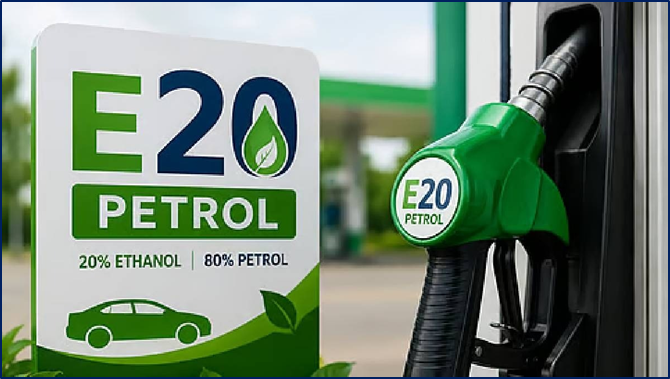
- E20 = Petrol containing up to 20% ethanol blended with gasoline, generally expressed by volume.
- It is part of India’s Ethanol Blended Petrol (EBP) Programme.
- Ethanol: Biofuel alcohol produced mainly from agricultural feedstocks such as sugarcane and grains.
- BIS standard IS 17021:2018 specifies E20 fuel as an admixture of 20% anhydrous ethanol + 80% ethanol-free motor gasoline.
Why is Ethanol Blended with Petrol?
- Reduce crude-oil imports and improve energy security.
- Promote domestic renewable fuel production.
- Provide an additional market for sugarcane, maize and other feedstocks.
- Reduce dependence on fossil fuels and potentially lower lifecycle greenhouse-gas emissions.
- Support farmers and the bioeconomy.
What did the Latest Testing Find?
1.According to the OMCs’ nationwide assessment:
- 100+ petrol samples were tested for chloride.
- Samples from refineries reportedly showed chloride levels of ≤1 ppm.
- Ethanol samples from around 80 distilleries were tested.
- E20 samples from 80+ depots/terminals were also examined.
- OMCs reported chloride levels in these E20 samples at below 3 ppm.
- They also stated that checks did not find water ingress in underground storage tanks across the fuel-station network.
2.Current controversy
- The issue gained attention after the Society of Indian Automobile Manufacturers (SIAM) had raised concerns about chloride/moisture and possible damage to vehicle components, but subsequently withdrew its earlier warning, stating that the data required further verification.
Why moisture is an Issue ?
- The issue is not that ethanol itself is a contaminant; the concern is about excess chloride/moisture beyond prescribed fuel-quality limits.
- Ethanol is hygroscopic, it has a strong tendency to absorb water.
- Excess water can potentially cause: Water ingress leading to ethanol-water interaction then phase separation & fuel-system/engine problems.
About Chloride
- Chloride/inorganic chloride can be an undesirable contaminant in fuel.
- At elevated concentrations, it can contribute to corrosion and deterioration of fuel-system components.
- Hence, fuel-quality standards prescribe limits for parameters such as inorganic chloride, water content, acidity and electrical conductivity.
Q. With reference to E20 petrol, consider the following statements:
1. E20 petrol contains 20% ethanol blended with 80% gasoline by volume.
2. Ethanol is hygroscopic and can absorb moisture from its surroundings.
3. The Ethanol Blended Petrol (EBP) Programme is implemented by the Ministry of Petroleum and Natural Gas.
Which of the statements given above is/are correct?
A. 1 and 2 only
B. 2 and 3 only
C. 1 and 3 only
D. 1, 2 and 3
Answer: D. 1, 2 and 3
Statement 1 is Correct: E20 petrol contains 20% ethanol and 80% gasoline by volume. The “20” in E20 specifically represents the ethanol percentage.
Statement 2 is Correct: Ethanol is hygroscopic, meaning it has a tendency to absorb water/moisture from the surroundings. Excess moisture can affect fuel quality and may contribute to phase separation and corrosion-related concerns.
Statement 3 is Correct: The Ethanol Blended Petrol (EBP) Programme is implemented under the Ministry of Petroleum and Natural Gas (MoPNG) to promote ethanol blending in petrol and reduce dependence on fossil fuels.