
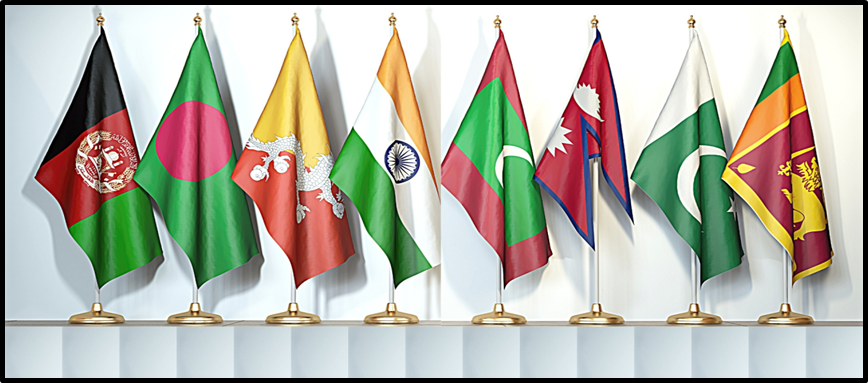
About SAFTA
- SAFTA (South Asian Free Trade Area) is a regional trade agreement among SAARC (South Asian Association for Regional Cooperation) member countries.
- It was signed in Islamabad on 6 January 2004 and came into force on 1 January 2006; its Trade Liberalisation Programme began on 1 July 2006.
- SAFTA replaced SAPTA (SAARC Preferential Trading Arrangement), 1993, shifting towards a phased reduction of regional tariffs.
Membership & Objectives
- Members: Eight SAARC states — Afghanistan, Bangladesh, Bhutan, India, Maldives, Nepal, Pakistan and Sri Lanka.
- Objectives: Eliminate barriers to trade in goods, reduce customs duties, promote fair competition and increase intra-regional trade and investment.
- Differentiated Design: Recognises differing levels of development among members, providing equitable benefits and support for least-developed countries (LDCs).
Trade Liberalisation Programme (TLP)
- First Phase: Non-LDC members — India, Pakistan and Sri Lanka — required to cut tariffs above 20% to 20% within two years; LDCs required to cut tariffs to 30% in the same period.
- Second Phase: Non-LDC members required to reduce tariffs further to the 0–5% range; LDCs given a longer period and special treatment — an asymmetric liberalisation design.
- Sensitive List: Each member maintains its own list of products excluded from tariff concessions, covering food security, small-scale industry and revenue-sensitive goods; this has limited SAFTA’s practical depth.
- Rules of Origin: Prevent trade deflection — re-export of non-member goods via the lowest-tariff member — using criteria such as change in tariff heading and domestic value addition, generally set at 60%, with a lower threshold for LDCs.
Institutional Mechanism
- Bodies: Operates through the SAFTA Ministerial Council, Committee of Experts and the SAARC Secretariat, along with national customs authorities.
- Functions: Provides for dispute-settlement procedures and periodic review of sensitive lists and rules-of-origin arrangements.
Performance Constraints
- Political Tensions: India–Pakistan relations have weakened SAARC institutions and restricted the framework’s full operation.
- Structural Barriers: Extensive sensitive lists, non-tariff barriers (licensing, quotas, standards, customs delays), poor connectivity and similar export structures across members limit integration.
- Institutional Weakness: SAFTA lacks a strong supranational authority; implementation depends on national governments prioritising domestic protection.
- Policy Shift: India has increasingly relied on bilateral and subregional arrangements — BBIN, BIMSTEC and bilateral treaties with Nepal, Bhutan, Sri Lanka and Bangladesh — reflecting difficulty in achieving SAARC-wide consensus.
Conclusion
SAFTA has helped promote regional trade through gradual tariff reduction, but its impact remains limited.Sensitive lists, non-tariff barriers, poor connectivity and India–Pakistan tensions have slowed its progress.
Therefore, India has increasingly focused on alternatives such as BIMSTEC and BBIN for stronger regional connectivity and cooperation.
| This concept has been elaborately discussed in the following article – DRI Uncovers Large-Scale Illegal Use of SAFTA Agreement in Areca Imports |