
About CAPFs
- The Central Armed Police Forces (CAPFs) are uniformed forces under the Ministry of Home Affairs (MHA). They help in border security, internal security, counter-insurgency and protection of important places.
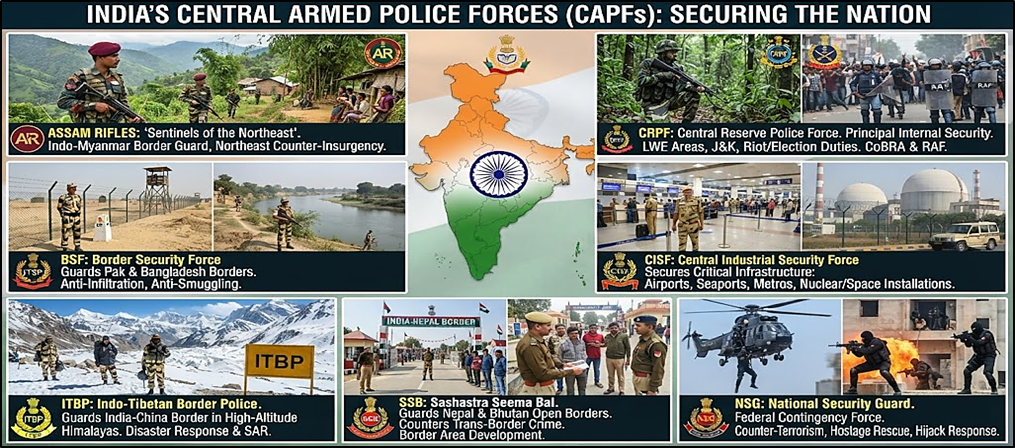
- The seven CAPFs are Assam Rifles, BSF, CRPF, CISF, ITBP, SSB and NSG. The NSG is a specialised force mainly used for counter-terrorism operations.
Key Functions of the Seven CAPFs
- Assam Rifles: Dual control administrative under MHA, operational under the Indian Army; guards the India–Myanmar border and conducts Northeast counter-insurgency.
- BSF: Guards borders with Pakistan and Bangladesh; anti-infiltration, anti-smuggling and wartime assistance to the Army.
- CRPF: Principal internal-security force Left-Wing Extremism (LWE) areas, Jammu & Kashmir, riot and election duties; specialised units CoBRA (jungle/anti-Naxal operations) and RAF (riot control).
- CISF: Secures critical infrastructure airports, seaports, metros, nuclear/space installations and PSUs.
- ITBP: Guards the India–China border in high-altitude Himalayan terrain; also conducts disaster and search-and-rescue operations.
- SSB: Guards open borders with Nepal and Bhutan; counters trans-border crime while supporting border-area development.
- NSG: A “federal contingency force” for counter-terrorism, hostage rescue, hijack response and bomb disposal; not used for routine law-and-order duties.
CAPFs and the Armed Forces: Institutional Distinction
- Administrative Control: CAPFs report mainly to the Ministry of Home Affairs; the Armed Forces report to the Ministry of Defence.
- Primary Role: CAPFs handle internal security, border guarding and assistance to civil authority; the Armed Forces handle external defence and war-fighting.
- Legal Orientation: CAPFs operate under a police/internal-security framework; the Armed Forces under a military service framework.
- Blurred Distinction: The line between the two narrows during war, counter-insurgency and major internal-security operations.
Federal Structure and Deployment
- Constitutional Position: Public order and police are primarily State subjects; national security and border management fall within the Union’s domain.
- Deployment Triggers: CAPFs assist states when local police capacity is insufficient, during elections, communal violence, LWE-affected districts, border infiltration or for major infrastructure protection.
- Coordination Network: Requires alignment among the Union government, State governments, State police, intelligence agencies, Armed Forces and district administration.
Conclusion
CAPFs’ effectiveness depends not just on manpower, but also on better coordination, modern technology and clear command structures. These factors help the seven CAPFs under the MHA effectively handle border security, internal security and counter-insurgency.
| This concept has been elaborately discussed in the following article – Ex-Agniveers to Get 50% Reservation in CAPFs & Assam Rifles |