
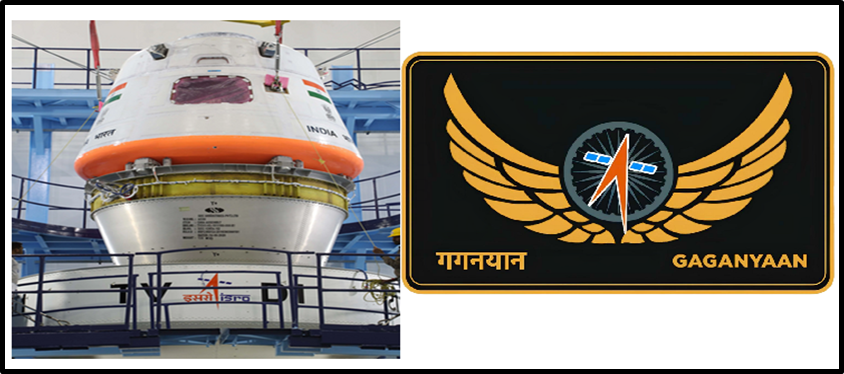
About the Gaganyaan Mission
Gaganyaan is India’s first indigenous human spaceflight mission, led by ISRO to send a three-member crew to about 400 km above Earth for three days and safely bring them back. If successful, India will become the fourth country to independently send humans into space, after the US, Russia and China.
Spacecraft Architecture: The Orbital Module
- The Orbital Module is the complete spacecraft section of Gaganyaan that carries and supports astronauts while they are in space.
- Gaganyaan’s Orbital Module consists of two main parts: the Crew Module (CM), where astronauts live, work and return to Earth, and the Service Module (SM), which provides power, propulsion and other essential support.
Launch Vehicle and Safety Systems
- Launch Vehicle: the customised, human-rated HLVM3, standing 53 metres tall and weighing 640 tonnes, comprising the HS200 solid strap-on boosters, the L110 twin-Vikas liquid core stage, and the CE-20 cryogenic C32 upper stage; acceleration is capped near 4g for crew comfort
- Human-Rating Features: quad-redundant navigation computers, triple O-ring segment joints, an integrated health monitoring system, and reduced chamber pressures in the HS200 and Vikas engines for added safety margin
- Crew Escape System (CES): a tower-mounted lifeboat with 5 quick-acting solid motors, including the Low-Altitude Escape Motor (LEM) and High-Altitude Escape Motor (HEM), to pull the Crew Module away during launchpad or flight emergencies
- Deceleration Parachutes: a 10-parachute redundant system comprising apex cover separation parachutes, drogue parachutes, pilot parachutes, and three 25-metre main parachutes, designed to land safely even if one main parachute fails
- Crew Module Uprighting System (CMUS): uses stored cold-gas to inflate flotation bags and roll a capsized Crew Module upright after splashdown
Mission Phases and Vyommitra
- Gaganyaan-1 (G1): an uncrewed end-to-end orbital test flight scheduled for the second half of 2026, carrying the humanoid robot Vyommitra in a depressurised cabin
- Gaganyaan-2 (G2) and Gaganyaan-3 (G3): planned for 2027; G2 will carry Vyommitra in a pressurised Crew Module to test the ECLSS, while G3 is the final uncrewed demonstration flight
- Gaganyaan-4 (H1): India’s first crewed flight, scheduled for the first quarter of 2027
- Vyommitra: an indigenous, female-looking half-humanoid robot developed at the Vikram Sarabhai Space Centre (VSSC), Thiruvananthapuram, first unveiled on 22 January 2020; built of aluminium alloy, she monitors cabin parameters, operates switches, and communicates in Hindi and English
- Astronaut-Designates: Group Captain Prasanth Balakrishnan Nair, Group Captain Ajit Krishnan, Group Captain Angad Pratap, and Wing Commander Shubhanshu Shukla, all Indian Air Force test pilots announced by Prime Minister Modi in February 2024, trained at Russia’s Yuri Gagarin Cosmonaut Training Centre
Strategic and Economic Significance
- Gaganyaan has a budget of ₹20,193 crore and involves strong participation from India’s private space industry, helping create jobs and develop advanced technologies.
- It will also lay the foundation for the Bharatiya Antariksh Station by 2035 and India’s planned crewed Moon mission by 2040.
Conclusion
Gaganyaan is an important step towards making India a major spacefaring nation by demonstrating its ability to send humans to space and bring them back safely. It will strengthen India’s space technology, scientific capabilities and international standing, while laying the foundation for future human space missions.
| This concept has been elaborately discussed in the following article – Gaganyaan’s Ablative Heat Shield: Protecting Astronauts During Re-entry |