
Context
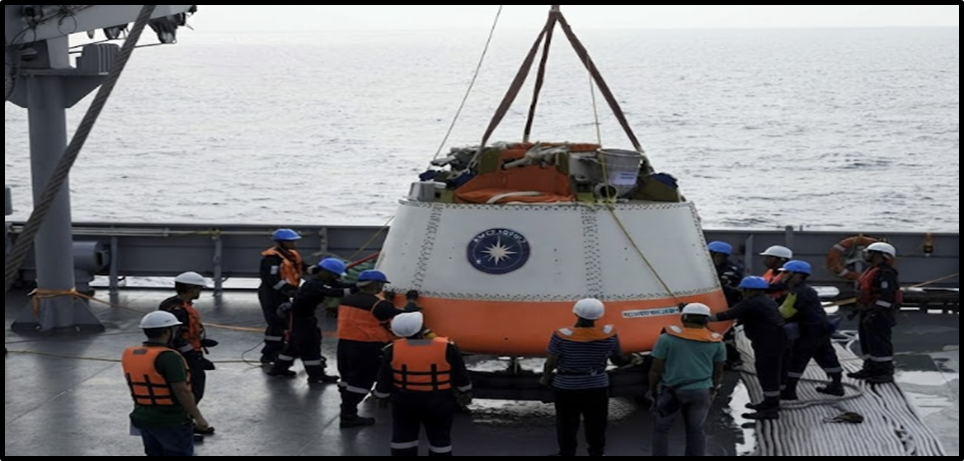
Recently, ISRO has developed an ablative Thermal Protection System (TPS) for Gaganyaan to protect the Gaganauts during atmospheric re-entry. At very high re-entry speeds, intense aerodynamic heating can raise the Crew Module’s outer surface to extremely high temperatures.
About Thermal Protection System (TPS)
A Thermal Protection System (TPS) is an advanced exterior shield designed to safeguard spacecraft from intense aerodynamic heating and thermal stress during atmospheric ascent and hypersonic re-entry.
Key Features of Gaganyaan’s Thermal Protection System (TPS)
- With its high efficiency it is a relatively thin ablative heat shield is designed to withstand extreme re-entry heat while keeping the crew compartment safe.
- It has a Dual-Material Design made of Carbon-phenolic protection is used at the nose for maximum heating, while silica-phenolic tiles protect the side and rear surfaces.
- It is simple yet durable with a single-use ablative design is more impact-tolerant and avoids the complex maintenance required by fragile reusable ceramic tiles.
- The system builds on ISRO’s earlier SRE and LVM3/CARE (2014) re-entry experiments.
Types of Thermal Protection Systems
- Ablative TPS: Sacrifices its outer layer by burning/eroding to absorb and carry away heat; mainly used for single-use spacecraft.
- Radiative TPS: Absorbs heat and releases it back into space as radiation, making it suitable for some reusable spacecraft.
- Heat Sink TPS: Absorbs and stores heat within the material without melting or breaking down, allowing it to withstand high temperatures.
Why Gaganyaan Uses an Ablative Thermal Protection System (TPS)
- Extreme Re-entry Heat: Gaganyaan’s high-speed atmospheric re-entry generates intense aerodynamic heating, making a reliable TPS essential to protect the crew and spacecraft.
- Effective Heat Protection: The ablative TPS gradually chars and erodes, absorbing and carrying away heat while keeping the crew compartment within safe temperature limits.
- Reliability & Cost-Effectiveness: It is well suited to the single-use Crew Module, requiring less complex maintenance and offering reliable protection against varying heat loads.
- Proven Heritage: The technology builds on ISRO’s experience with ablative heat shields used in the SRE and CARE missions.
India’s Ablative Heat Shield Heritage
- Space Capsule Recovery Experiment (SRE): India’s maiden re-entry mission; used a carbon phenolic ablative to protect the module’s nose cap, where heat flux was highest.
- LVM-3/CARE Mission: ISRO’s 2014 mission successfully demonstrated crew module re-entry using an ablative TPS, establishing the foundational technology now used in the Gaganyaan programme.
- Global Comparator: SpaceX’s Crew Dragon capsule uses PICA (phenolic-impregnated carbon ablator), a lightweight carbon fibre matrix filled with phenolic resin.
Why is this article important for UPSC?
- Understanding the working of a Thermal Protection System (TPS), which is relevant to India’s human spaceflight programme as space technology is an important UPSC Science and Technology concept.
- To have Knowledge of ISRO’s re-entry technology heritage, including the SRE and LVM-3/CARE missions which are highly relevant for UPSC.
- Awareness of the Gaganyaan programme’s engineering milestones supports questions on India’s space missions and indigenous technology development.
In this article, you will understand:
- Re-entry heat challenges for the Gaganyaan module
- Types of Thermal Protection Systems
- ISRO’s ablative heat shield heritage
| Important CTC from this article for UPSC Gaganyaan Mission Thermal Protection System in Rockets |
Q. With reference to India's Thermal Protection Systems (TPS) for re-entry, consider the following statements:
I. The Gaganyaan crew module will encounter re-entry temperatures as high as 1,800°C.
II. An ablative TPS is a reusable thermal protection system that changes phase to absorb heat.
III. ISRO's Space Capsule Recovery Experiment (SRE) was India's maiden re-entry mission and used a carbon phenolic ablative TPS.
Which of the statements given above is/are correct?
(a) I and II only
(b) II and III only
(c) I and III only
(d) I, II and III
Answer: (c) I and III only
Explanation
Statement I is Correct: During re-entry, the exterior of the Gaganyaan crew module will encounter temperatures as high as 1,800°C in some regions.
Statement II is Incorrect: An ablative TPS is a single-use system, not reusable — it removes heat by sacrificing material through chemical and physical decomposition. A heat sink TPS absorbs heat without changing phase, and a radiative TPS is reusable but works differently, by re-radiating heat as electromagnetic radiation.
Statement III is Correct: India's maiden re-entry mission, the Space Capsule Recovery Experiment (SRE), used a carbon phenolic ablative to protect the module's nose cap, where heat flux was highest.