
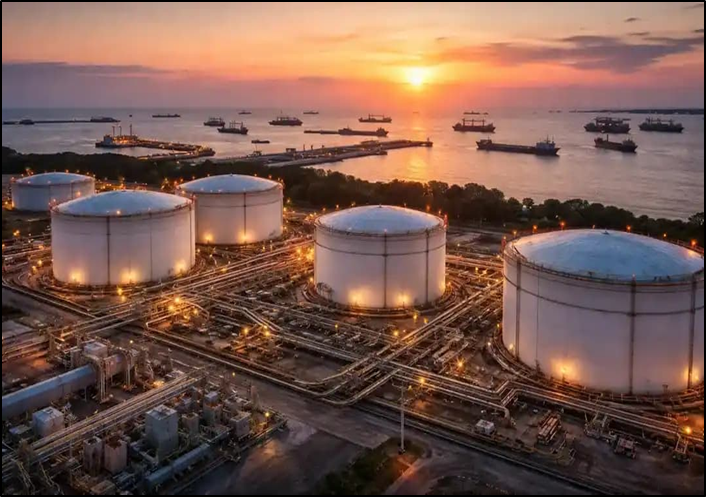
What are Strategic Petroleum Reserves (SPRs)?
Core Concept: Government-maintained emergency crude oil stockpiles used exclusively during supply chain disruptions, completely distinct from routine commercial stocks held by oil marketing companies.
- Implementing Agency: Indian Strategic Petroleum Reserves Limited (ISPRL)—a Special Purpose Vehicle (SPV) established in 2004.
- Nodal Ministry: Administered under the Ministry of Petroleum and Natural Gas (MoPNG).
- Storage Technology: Crude oil is secured in specialized, unlined underground rock caverns located deep below the earth’s surface, predominantly situated near coastal areas for rapid maritime accessibility.
Mapping India’s SPR Infrastructure
1. Phase-I Facilities (Operational capacity of 5.33 MMT):
- Visakhapatnam (Andhra Pradesh)
- Mangaluru (Karnataka)
- Padur (Karnataka)
2. Phase-II Expansion (Approved in 2021 for an additional 6.5 MMT):
- Chandikhol (Odisha)
- Padur Phase-II (Karnataka)
Why are SPRs Strategically Significant?
- Energy Security: Acts as a sovereign shield during extreme contingencies like wars, natural disasters, or maritime shipping blockades.
- Economic Stability: Functions as a critical market stabilization tool, protecting the national economy from sudden imported inflationary shocks during global price surges.
- Strategic Autonomy: Drastically reduces New Delhi’s vulnerability to external geopolitical dynamics and the coercion of global energy cartels.
Key Challenges & Vulnerabilities
- Severe Capacity Deficit: India’s current operational SPR capacity is critically low and falls significantly short of the 90-day net import benchmark mandated by the International Energy Agency (IEA).
- Policy Ambiguity: There remains a lack of a clearly defined, dynamic policy or trigger mechanism regarding exactly when to release these reserves during instances of high price fluctuations versus actual physical supply deficits.
Conclusion
- Expanding India’s SPR capacity is vital to bridging the 90-day IEA benchmark and safeguarding national energy sovereignty against volatile global supply disruptions.
| This Concept has been Elaborately Discussed in the following Article: Beyond Barrels: India’s Blueprint for a $42 Billion Strategic Energy Shield |