
After Reading This Article You Can Solve This UPSC Mains Model Question:
Examine the need for expanding India’s strategic reserves into a multi-fuel architecture. What are the key infrastructural and fiscal bottlenecks in its implementation? 10 Marks (GS-3, Economy)
Context
West Asia-related disruptions have exposed critical vulnerabilities in India’s energy-security system. While India imports vast quantities of fossil fuels, its capacity to store and release these fuels during prolonged geopolitical supply shocks remains severely constrained.
Introduction
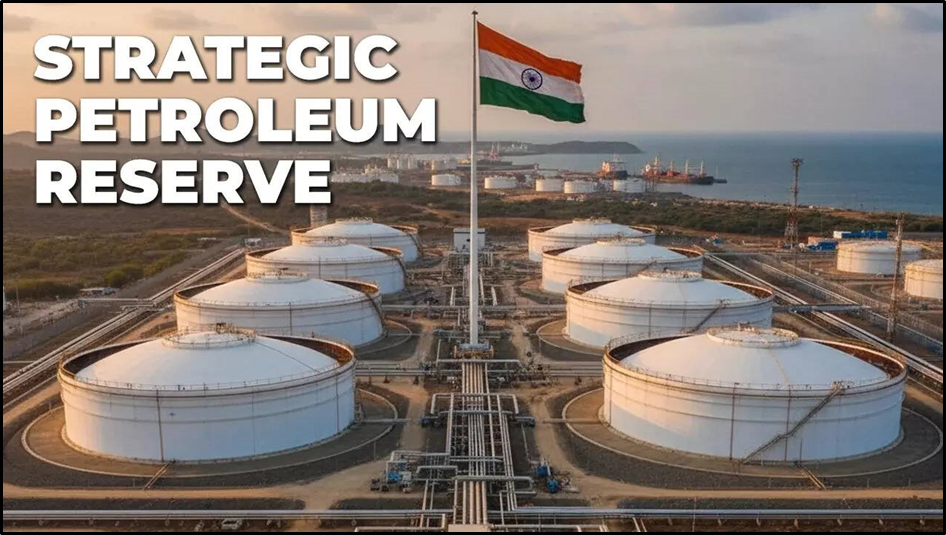
To buffer the economy against volatile supply disruptions, the Indian government is evaluating a $42 billion, decade-long strategic fuel program. This initiative aims to transition India from managing short-term market fluctuations to building a robust, multimodal energy-defense architecture across crude oil, natural gas, and LPG.
About Strategic Petroleum Reserves (SPRs)
- Definition: SPRs are dedicated, large-scale emergency stockpiles of crude oil maintained by sovereign nations.
- Purpose: They serve exclusively as a strategic buffer against sudden supply chain disruptions and price shocks, operating entirely independently of routine commercial inventories.
Historical Background
- Origin: The concept of sovereign SPRs emerged globally following the 1973 Oil Crisis, triggered by an Arab oil embargo.
- Global Standard: Since then, major oil-importing economies like the US, China, and Japan have maintained massive reserves to stabilize domestic markets during crises.
India’s Oil Stockpiles: Current Status
- Market Position: India is the world’s third-largest consumer of crude oil, with an import dependency exceeding 88%.
- Inherent Vulnerability: This heavy reliance leaves the macroeconomic framework highly exposed to external supply chokepoints.
- The Gas/LPG Deficit: Beyond crude, India currently operates zero underground natural gas storage facilities and a minimal 0.14 MT of LPG capacity, relying almost entirely on real-time maritime logistics.
The IEA Benchmark Comparison
- The Mandate: The International Energy Agency (IEA) recommends member nations maintain oil stocks equivalent to 90 days of net imports.
- India’s Reality: As an Associate Member, India’s total national storage—combining strategic reserves and commercial refinery stocks—currently stands at just 74 days.
India’s Existing SPR Infrastructure
- Management: Monitored by the Indian Strategic Petroleum Reserve Limited (ISPRL).
- Phase I Footprint: Comprises three underground rock caverns totaling 5.33 million tonnes (MT) at Visakhapatnam, Mangaluru, and Padur.
- Utilization Gap: Operating at only ~64% capacity (holding ~3.37 MT), Phase I provides a thin buffer covering roughly 9.5 days of India’s crude needs.
Planned Expansion: Future SPR Sites
- Approved Expansion: Phase II targets a 6.5 MT addition via reserves at Chandikhol (4 MT) and a Padur expansion (2.5 MT).
- Proposed Additions: Pending proposals for Bikaner and Rajkot aim to add another 6 MT.
- Long-Term Vision: The overarching masterplan targets an additional 28 MT of crude (two months cover), 9 MT of LNG (56 days cover), and 4 MT of LPG (six weeks cover).
Significance of the Fuel Plan
- Macroeconomic Stability: Absorbs imported inflation shocks, protecting the national fiscal deficit and preventing sudden retail price hikes.
- Securing the Energy Transition: Constructing 9 MT of LNG storage ensures a steady supply of natural gas, a critical “bridge fuel” for India’s transition to renewable energy.
- Strategic Autonomy: Empowers New Delhi to maintain an independent foreign policy without coercion from energy cartels during international conflicts.
- Upgraded Sectoral Resilience: Expanding LPG and gas buffers shields domestic cooking gas supplies and priority industrial sectors (e.g., fertilizers) from supply chokepoints.
- Supply Chain Sovereignty: Synergizes with domestic maritime capacity building, directly reducing India’s historical reliance on foreign-owned shipping fleets.
Associated Challenges
- Astronomical Capital Drain: Funding the estimated $42 billion for infrastructure (CAPEX) without levying a direct public cess poses a severe fiscal challenge.
- Implementation Paralysis: Approved Phase II projects remain stalled by complex land acquisition hurdles and friction in Public-Private Partnership (PPP) finalizations.
- Inventory Price Traps: Replenishing emergency stocks post-crisis may force the government to procure fuel at highly inflated global commodity and freight rates.
- Geological Complexity: Constructing underground LNG/gas storage requires specialized engineering for identifying depleted reservoirs or constructing solution-mined salt caverns.
- Infrastructure Synchronization: Storage is ineffective unless cavern extraction rates are perfectly synchronized with inland regasification units, bottling plants, and downstream pipeline grids.
Strategic Way Forward
- Scale Hybrid Funding Models: Aggressively replicate the commercial-cum-strategic foreign leasing model to subsidize public infrastructure costs and offset capital expenditure.
- Fast-Track Statutory Approvals: Expedite land clearances and administrative finalizations for the pending Bikaner and Rajkot sites to rapidly close the gap toward the 90-day IEA benchmark.
- Accelerate Subsurface Exploration: Initiate immediate geological mapping of sedimentary basins (Krishna-Godavari, Cambay) to identify viable depleted reservoirs for natural gas injection.
- Establish Clear Governance Protocols: Formulate a statutory policy clearly defining trigger mechanisms for emergency stock releases and the allocation of replenishment risks.
- Synchronize Inland Grid Expansion: Ensure the recent authorization of 1,800 km of new LPG pipelines is completed concurrently with storage construction to guarantee inland deliverability.
- Diversify Import Origins: Actively reduce Middle East dependence by finalizing supply contracts with North American and African suppliers while acquiring sovereign Very Large Gas Carriers (VLGCs).
Conclusion
True energy security transcends the mere excavation of physical storage space. India must seamlessly synchronize its expanded underground reserves with sovereign maritime shipping assets, robust inland pipeline grids, and a commercially viable governance framework. Securing strategic autonomy in the 21st century relies entirely on executing this integrated infrastructure ecosystem before the next global supply crisis materializes.
| Important Current to Concept (CTC) from this Article for UPSC Strategic Petroleum Reserves |