
Introduction
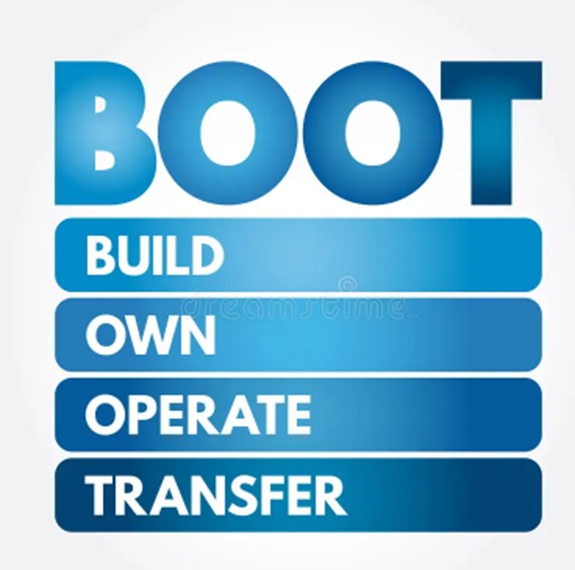
The Build-Own-Operate-Transfer (BOOT) model is a form of Public-Private Partnership (PPP) in which a private entity finances, constructs, owns and operates an infrastructure project for a specified period before transferring it to the government.
Key Features of the BOOT Model
- Build: The private partner is responsible for designing and constructing the infrastructure project using its own or mobilised financial resources.
- Own: The private entity retains ownership of the project during the concession period, subject to the terms of the PPP agreement.
- Operate: The private partner operates and maintains the project for a predetermined period and recovers its investment through user charges, tariffs or other project revenues.
- Transfer: At the end of the concession period, the infrastructure is transferred to the government or designated public authority, generally according to predefined conditions.
- Fixed concession period: The government grants the private entity the right to develop and operate the project for a specified period, after which ownership/control is transferred.
Why is the BOOT Model Important for India?
- Mobilisation of private capital: BOOT enables the government to leverage private-sector investment for capital-intensive infrastructure without bearing the entire upfront cost.
- Infrastructure creation: It can accelerate the development of roads, highways, airports, ports, power projects and urban infrastructure.
- Technical efficiency: Private participation can introduce modern technology, managerial expertise and operational efficiency.
- Reduced fiscal pressure: Since the private partner undertakes significant upfront investment, the model can reduce the government’s immediate fiscal burden.
- Life-cycle management: Since the private entity is responsible for construction and operation, there can be greater incentives for quality construction and efficient maintenance.
- Economic growth: Better infrastructure improves connectivity, logistics efficiency, investment climate and regional development, thereby supporting economic growth.
BOOT Model in the Context of Airports and Infrastructure
- The BOOT framework can be useful for large infrastructure projects such as airports because it allows the government to combine public oversight with private investment and operational expertise.
- In the case of large greenfield infrastructure, private participation can help mobilise substantial capital while the government focuses on policy, regulation, land-related issues and public interest safeguards.
- However, projects such as the Parandur airport controversy demonstrate that financial and technical feasibility alone are insufficient; infrastructure PPPs must also address land acquisition, environmental sustainability, rehabilitation and community participation.
BOOT vs Traditional Public Procurement
| BOOT Model | Traditional Government Procurement |
| Private sector undertakes major investment. | Government bears major investment expenditure. |
| Private entity builds and operates the project. | Government/public agency generally operates the project. |
| Private entity bears substantial project and revenue risks. | Government bears greater financial and operational risks. |
| Ownership/control is transferred after the concession period. | Public ownership generally exists from the beginning. |
| Encourages private-sector efficiency and innovation. | Greater direct public control but potentially higher fiscal burden. |
Conclusion
The BOOT model can help bridge India’s infrastructure financing gap by combining public oversight with private capital and efficiency. Its success, however, depends on sound contracts, balanced risk allocation, regulatory certainty and strong protection of public interest.
| This Concept Has Been Elaborately Discussed In The Article: Parandur Airport Controversy: Balancing Infrastructure Development, Environmental Sustainability and Livelihood Security |