
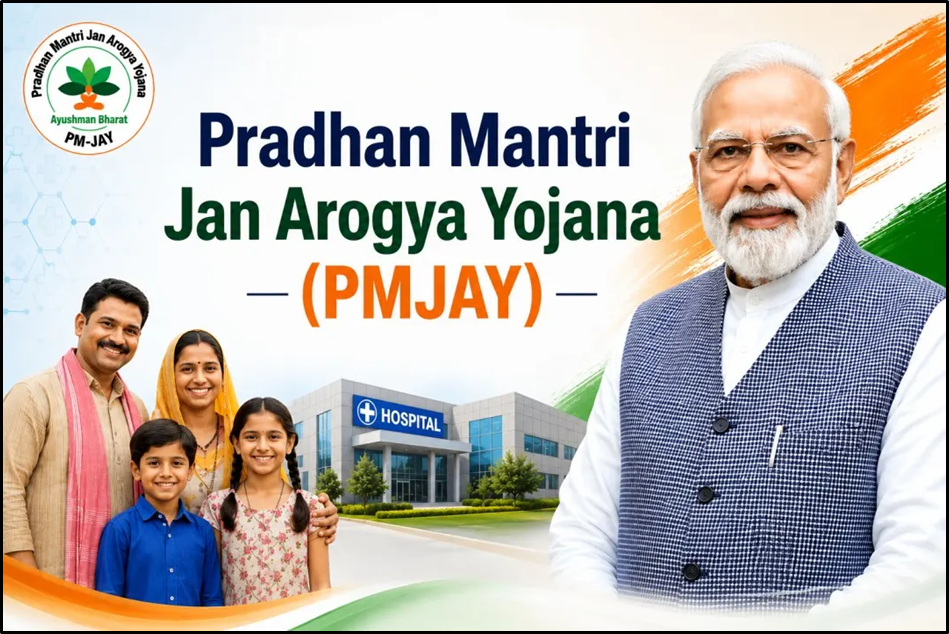
The Pradhan Mantri Jan Arogya Yojana (PM-JAY) is the world’s largest government-funded health assurance scheme, aiming to transition India towards Universal Health Coverage (UHC) by providing cashless secondary and tertiary care.
Core Institutional Architecture & Vision
- Dual Pillar Strategy: Ayushman Bharat integrates two fundamental pillars to ensure a continuum of care:
- Health and Wellness Centres (HWCs): Upgraded Sub-Centres and PHCs delivering Comprehensive Primary Health Care (CPHC), free diagnostics, and preventive care.
- PM-JAY: Focuses exclusively on curative secondary and tertiary hospitalization.
- Funding & Implementation: It is a Centrally Sponsored Scheme (typically a 60:40 cost-sharing ratio with states). Implementation is managed by State Health Agencies (SHAs) under the apex National Health Authority (NHA), utilizing Trust, Insurance, or Mixed (Hybrid) models.
PM-JAY: Eligibility & Unprecedented Coverage Expansion
- Base Target Demographic: Targets the bottom 40% of India’s population, covering over 12 crore poor and vulnerable families (approximately 55 crore individuals).
- Primary Inclusion Criteria: Historically determined by deprivation indicators under the Socio-Economic Caste Census (SECC) 2011. It subsumed the older Rashtriya Swasthya Bima Yojana (RSBY).
- Universal Senior Citizen Expansion (Latest Update): In a landmark expansion, all citizens aged 70 years and above are now eligible for a ₹5 lakh health insurance coverage per year, irrespective of their income or socio-economic status.
Key Features & Beneficiary Safeguards
- Financial Cover: Provides a cashless and paperless cover of ₹5 lakh per family per year on a family floater basis.
- Zero Demographic Caps: Uniquely imposes no restriction on family size, age, or gender.
- Comprehensive Hospitalization: Covers over 1,900 medical procedures (including surgeries, ICU care, implants, and physician fees) and mandates day-one coverage of all pre-existing conditions.
- Pre & Post-Care Integration: Mandates coverage for 3 days of pre-hospitalization diagnostics and 15 days of post-hospitalization medicines and care.
- National Portability: Beneficiaries can avail of cashless treatment at any empanelled public or private hospital across the country.
Systemic Challenges & Implementation Lacunae
- Exclusion of Outpatient Care: The scheme strictly covers hospitalization, excluding Outpatient Department (OPD) expenses, which constitute the bulk of out-of-pocket expenditure for chronic illnesses.
- Private Sector Hesitancy: Many top-tier private hospitals avoid empanelment, citing unviable, low government reimbursement package rates and delayed claim settlements.
- Leakages & Fraud: Instances of ghost beneficiaries, identity spoofing, and hospitals claiming funds for unwarranted surgical procedures.
- Infrastructure Deficit: Severe shortages of specialists and ICU beds in tier-2 and tier-3 public hospitals force a heavy reliance on the concentrated urban private sector.
Conclusion
As the cornerstone of India’s push for Universal Health Coverage, PM-JAY effectively democratizes access to life-saving tertiary care. However, ensuring its long-term sustainability requires rationalizing package rates to incentivize private sector participation, expanding coverage to critical outpatient services, and rigorously curbing fraudulent claims through robust digital audits.
| This Concept has been discussed in the following article: Towards Equitable Healthcare: Regulating Private Capital and Patient Welfare |