
Context
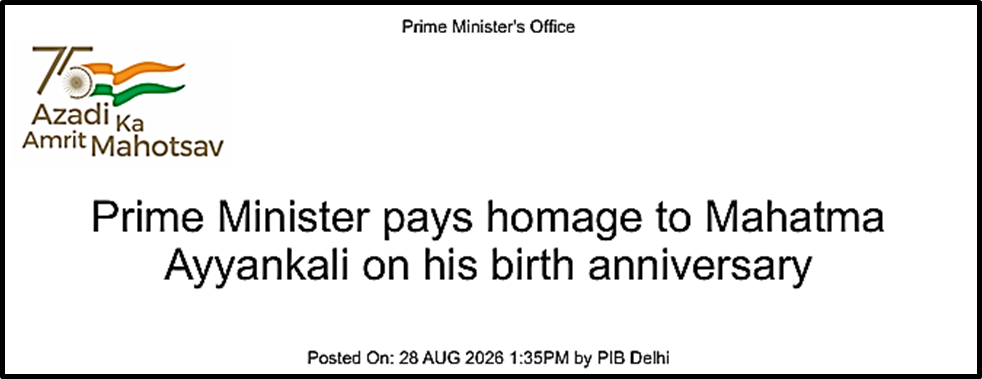
- Recently, the Prime Minister’s Office paid homage to Mahatma Ayyankali on his birth anniversary, highlighting his pioneering role in social justice and empowerment of the marginalised, as noted by Prime Minister Narendra Modi.
- His contributions included advancing educational access, improving the welfare of agricultural labourers, and serving the poor.
Historical Background
- Mahatma Ayyankali (1863–1941): A prominent social reformer from Kerala who fought for the rights of oppressed and marginalized communities.
- “Pulaya Raja”: Widely known as “Pulaya Raja” for his leadership and social reforms.
- Birth: Born on 28 August 1863 at Venganoor, Thiruvananthapuram, in the Pulaya community.
- He passed away on 18 June 1941.
- Caste Discrimination: Personally faced severe caste discrimination in 19th-century Kerala.
- Life Mission: These experiences inspired him to fight caste inequality and uplift oppressed communities.
Institutional Leadership & Reform Initiatives
- Sadhu Jana Paripalana Sangham (SJPS): Founded by Ayyankali to unite and raise the voice of the underprivileged.
- Public Roads: Fought for equal and unrestricted access to public roads.
- Education: Struggled to secure school admission for oppressed-class children.
- Workers’ Rights: Demanded fair wages and better working conditions for labourers.
- Sree Moolam Praja Sabha: Became a member of Travancore’s legislative assembly, giving marginalized communities a voice in governance.
Milestone Protests & Emancipation Campaigns
- The Villuvandi Demonstration (1893): Ayyankali directly challenged rigid caste restrictions governing public movement by driving a bullock cart (villuvandi) through the public roads of Venganoor, creating a historic symbol of civic freedom and spatial rights.
- The Kallumaala Agitation: He targeted the oppressive tradition requiring women from oppressed strata to wear stone bead necklaces (kallumaala) as badges of inferiority, successfully urging women to cast them off as an assertion of self-respect and social liberation.
- Educational Empowerment: Recognizing literacy as an essential tool against subjugation, Ayyankali established a dedicated school for depressed-class children in 1904 and continuously lobbied for universal educational rights.
- Labor Rights Mobilization: He organized agrarian workers to advocate for improved working conditions and equitable remuneration, successfully merging social emancipation with economic justice.
Conclusion
Mahatma Ayyankali (1863–1941) was a pioneering social reformer who worked for the education, dignity and rights of marginalised communities and played an important role in Kerala’s social-justice movement.” Honourable Prime Minister’s tribute on his birth anniversary highlights the continuing relevance of Ayyankali’s ideals of social justice, education, dignity of labour and empowerment of the marginalised.
| Important CTC from this article for UPSC Mahatma Ayyankali |