
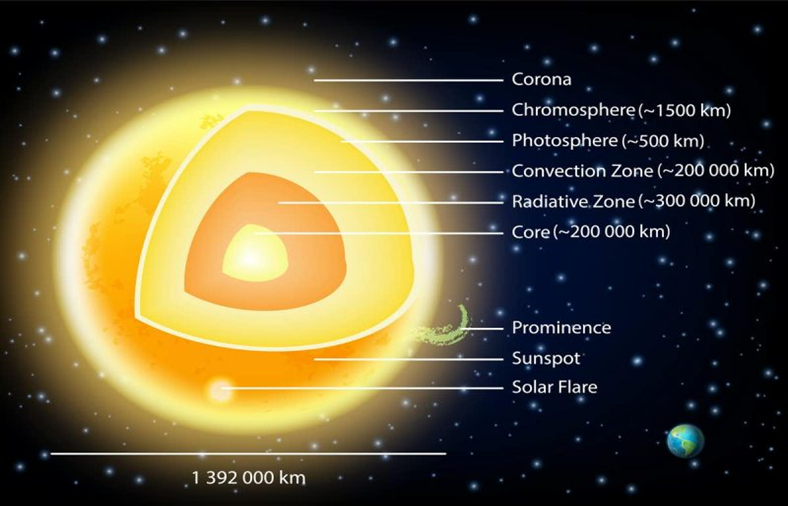
About the Solar Atmosphere
- Definition: The Sun’s atmosphere is divided into distinct layers characterized by a transition from gravity-dominated fluid dynamics in the lower layers to magnetohydrodynamics dominated by magnetic fields in the outer layers.
- Layer order (innermost to outermost): Photosphere → Chromosphere → Transition Region → Corona.
The Photosphere
- Nature: The lowest, coolest, and only directly visible layer; source of nearly all visible sunlight and heat, and where absorption lines are imprinted on the solar spectrum.
- Granular structure: Exhibits convective granules of hot plasma averaging 1,500 km in diameter, separated by cooler downflow lanes.
- Magnetic concentration: Convective flows sweep magnetic field lines into downflow lanes (flux expulsion); convective collapse amplifies field strength in flux tubes up to 150 mT.( mT = millitesla – the SI unit of magnetic flux density (field strength). One tesla (T) equals 1,000 millitesla.)
The Chromosphere
- Extent: Lies directly above the photosphere, extending to about 2,000 km.
- Visibility and colour: Normally invisible from Earth but seen as a reddish flash during total solar eclipses, due to emission of the first Balmer line of hydrogen (H-alpha).
- Temperature and density: Temperature rises with altitude, from 6,000°C to about 20,000°C, while density drops by a factor of 10⁴ relative to the photosphere.
- Dynamic features: Populated by spicules – jets of hot gas reaching 10,000 km, lasting up to 14 minutes – and straight/slanted fibrils.
The Transition Region
- Nature: A narrow, irregular boundary (thickness of tens to hundreds of km) separating the chromosphere from the million-degree corona.
- Temperature catastrophe: Full ionization of helium stops efficient radiative cooling, causing a rapid temperature jump to nearly 1 million Kelvin.
- Plasma beta shift: Marks the transition from high-beta plasma (gas pressure dominant) below to low-beta plasma (magnetic pressure dominant) above.
- Spectral shift: Spectral lines shift from absorption (visible/near-UV) below to emission (far-UV and X-ray) above.
The Corona
- Nature: The Sun’s outermost atmosphere, visible during total solar eclipses as a glowing white crown; emits heavily in X-rays due to extreme ionization.
- Coronal heating paradox: Since the photosphere (~5,800 K) is cooler than the corona, heat cannot flow directly by conduction; energy is carried by non-thermal mechanisms such as magnetic field-line braiding and nanoflares.
- Solar wind and Alfvén surface: The corona expands outward as the solar wind; the boundary where it merges with the wind is the Alfvén surface, located 10 to 20 solar radii above the photosphere.
Conclusion
The solar atmosphere transitions sharply from the relatively cool, gravity-governed photosphere and chromosphere through the narrow transition region into the magnetically dominated, super-heated corona.
The coronal heating paradox – the corona being far hotter than the surface below it – remains a central unresolved problem in solar physics, addressed by missions such as Aditya-L1.
| This concept has been elaborately discussed in the following article – · Aditya-L1 Detects Early Signs of Solar Flares. |