
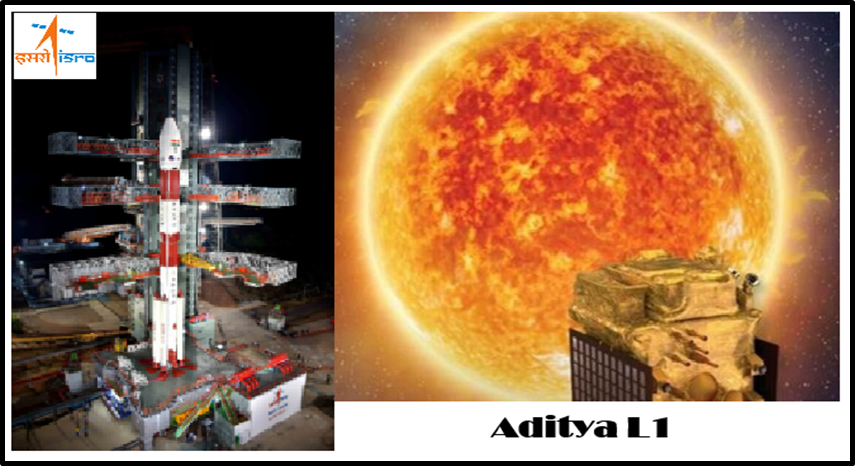
About Aditya-L1
- Aditya-L1 is India’s first space-based solar observatory, launched by Indian Space Research Organisation (ISRO) in September 2023.
- It is positioned near the Sun–Earth L1 Lagrange point, about 1.5 million km from Earth.
The mission studies the Sun’s photosphere, chromosphere and corona, including solar flares and coronal mass ejections - Its observations help improve understanding and forecasting of space weather and its effects on Earth.
Strategic Value of the L1 Point
- Continuous solar view: The Sun is never blocked by Earth, enabling round-the-clock observation without eclipses.
- Fuel efficiency: Balanced gravitational pull of Sun and Earth at L1 minimizes station-keeping fuel needs.
- Early storm warning: Detects solar wind and coronal mass ejections (CMEs) nearly an hour before they reach Earth.
- Outside the magnetosphere: Enables direct, unshielded in-situ sampling of solar wind before Earth’s magnetic field alters it.
Primary Scientific Objectives
- Coronal Heating Problem: Investigates why the corona (over 1,000,000°C) is far hotter than the photosphere (5,500–6,000°C).
- CMEs and Solar Flares: Monitors plasma and magnetic-energy eruptions and their triggering processes.
- Space Weather Prediction: Provides real-time data to forecast geomagnetic disturbances threatening GPS, satellite communication, and power grids.
The Seven Payloads
| Payload | Developer / Function |
| VELC (primary payload) | IIA, Bengaluru — studies solar corona and CMEs using onboard AI |
| SUIT | IUCAA, Pune — images photosphere/chromosphere in Near-UV (200–400 nm) |
| SoLEXS | URSC, Bengaluru — soft X-ray spectrometer (1–30 keV) for flare intensity |
| HEL1OS | URSC — hard X-ray spectrometer (10–150 keV), CdTe/CZT detectors |
| ASPEX | PRL, Ahmedabad — solar wind particle experiment (SWIS + STEPS) |
| PAPA | VSSC, Thiruvananthapuram — analyses solar wind electrons/ions (SWEEP, SWICAR) |
| MAG | LEOS, Bengaluru — twin tri-axial fluxgate magnetometers on a 6-m boom |
Key Scientific Milestones
- Gannon’s Storm mapping: During the May 2024 Gannon’s Storm (strongest of the 21st century so far), Aditya-L1’s magnetometer mapped a 1.3-million-km magnetic reconnection region — the first direct space observation of such an event.
- First NUV flare kernel image: On February 22, 2024, SUIT, SoLEXS, and HEL1OS jointly captured the first close-up image of an X6.3-class solar flare kernel in near-ultraviolet light.
- First spectroscopic CME observation: In 2025, a joint IIA–NASA effort used the VELC payload to record the first spectroscopic observations of a CME close to the Sun in visible wavelength.
Conclusion
Aditya-L1, parked in a halo orbit around Lagrange Point 1, gives India continuous, unshielded solar observation capability through seven indigenous payloads split between remote-sensing and in-situ measurement.
Its milestone discoveries — including the first direct mapping of a major magnetic reconnection region during the 2024 Gannon’s Storm — have already advanced global understanding of the coronal heating problem and space weather.
| This concept has been elaborately discussed in the following article – · Aditya-L1 Detects Early Signs of Solar Flares |