
Context
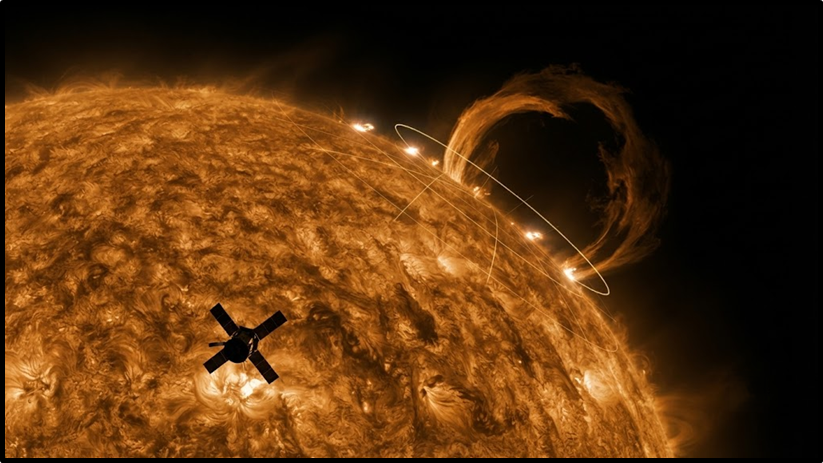
- RecentlyAditya-L1 has detected small, short-lived brightening events on the Sun that occur hours before a major solar flare. These events were found to cluster around the same location where the major flare later occurs, suggesting they are early warning signs.
What Researchers Discovered
- Small, short-lived brightening events appear in active regions hours before major solar flares.
- Some of these events also produced X-rays, showing that magnetic energy was being released.
- These small events clustered around the exact area where the major flare later occurred.
- Repeated small energy releases may gradually destabilise the Sun’s magnetic field, eventually triggering a major flare.
- The discovery could help scientists predict solar flares earlier and improve space-weather forecasting.
Significance of this Observation & The Study Details
- This could help scientists predict solar flares and improve space-weather forecasting, protecting satellites, astronauts, GPS and communication systems.
- The study was led by researchers from MAHE/Manipal Centre for Natural Sciences, with ISRO and Department of Space scientists, using UV and X-ray observations from Aditya-L1.
About Aditya-L1 Mission
- Aditya-L1 is India’s first dedicated space mission to study the the photosphere, chromosphere and corona to understand solar activity of the Sun.
- It was launched by ISRO on 2 September 2023 using the PSLV-C57.
- The spacecraft is placed around the L1 (Lagrange Point 1), about 1.5 million km from Earth.
- L1 provides a continuous, unobstructed view of the Sun without Earth blocking it.
- Its 7 payloads observe the Sun in visible, UV and X-ray wavelengths to study solar flares, CMEs and solar wind, aiding space-weather forecasting.
What are Solar Flares
- Solar flares are sudden, powerful bursts of energy and radiation from the Sun.
- They occur when the Sun’s magnetic fields suddenly break and reconnect, releasing huge energy.
- They are usually produced in active regions of the Sun, often around sunspots.
- Strong flares can release X-rays and ultraviolet radiation that reach Earth.
- They can disturb satellite communications, GPS, radio signals and power systems.
- Solar flares are an important part of space weather and can also be linked with coronal mass ejections (CMEs).
Mechanism of Solar Flares
- Transient Brightening: Identified numerous small, short-lived brightening events clustering around active locations hours before major flares erupt.
- Energy Release: Indicates that repeated small-scale energy releases progressively destabilize coronal magnetic fields in active solar regions.
- Coronal Link: Demonstrates how lower solar atmospheric activity links directly to high-energy magnetic energy release in the solar corona.
Scientific Significance & Space Weather of Flare forecasting
- Flare Forecasting: Brings scientists significantly closer to establishing reliable flare forecasting and advanced space weather prediction models.
- Asset Protection: Critically helps protect vital space assets, including satellites, astronauts, power grids, and terrestrial communication systems.
Conclusion
The detection of pre-flare transient brightening events through Aditya-L1 payload observations provides essential foundational insights into solar flare triggers, significantly strengthening space weather forecasting capabilities.
| Important CTC from this article for UPSC Aditya L1 Mision Atmosphere of the Sun |
Q. Consider the following statements regarding the recent study on solar flares:
I. Small, short-lived brightening events cluster around the eventual flare location hours before eruption.
II. Ground-based observatories alone captured all near-ultraviolet wavelengths without atmospheric interference.
III. The Aditya-L1 mission includes payloads such as SUIT, SoLEXS, and HELIOS.
Which of the statements given above is/are correct?
a. I and II only
b. I and III only
c. II and III only
d. I, II, and III
Answer: b. I and III only
Explanation
Statement I is Correct: Researchers found that numerous small, short-lived brightening transient events occur and cluster around active regions hours before major solar flares erupt.
Statement II is Incorrect: Near-ultraviolet (NUV) wavelengths are largely inaccessible from ground-based observatories because Earth's atmosphere absorbs most ultraviolet radiation; space-borne instruments like SUIT on Aditya-L1 are required.
Statement III is Correct: The Aditya-L1 mission carries simultaneous UV and X-ray payloads, including the Solar Ultraviolet Imaging Telescope (SUIT), SoLEXS, and HELIOS.