
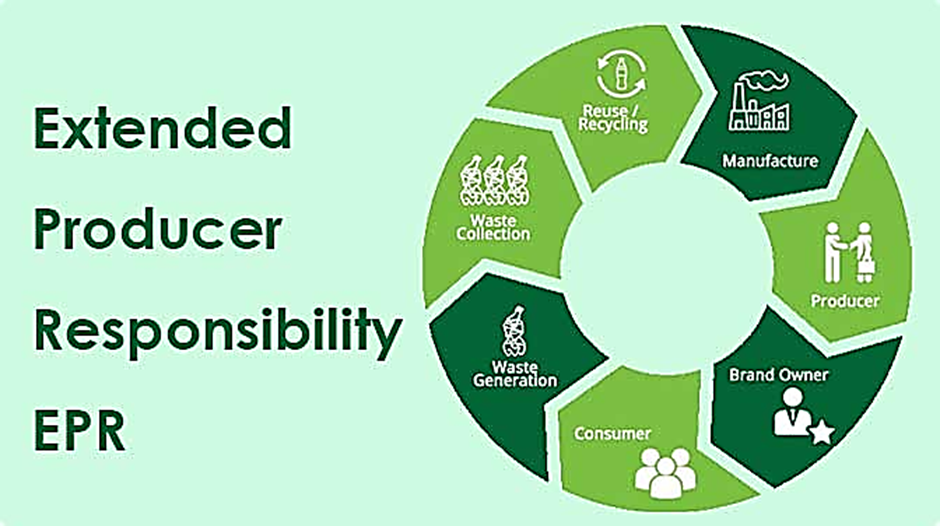
About Extended Producer Responsibility
Extended Producer Responsibility (EPR) is a policy framework that holds producers, importers, and brand owners legally and financially accountable for the end-of-life management—including collection, recycling, and safe disposal—of their products.
Core Objectives
- Cost Shifting: Transfers the financial burden of solid waste management from local municipalities to the producers.
- Circular Economy: Transitions from a linear “take-make-dispose” model to a circular system focused on continuous material recovery.
- Eco-Design & Resource Efficiency: Incentivizes manufacturers to design highly recyclable products, thereby reducing pollution and the extraction of virgin raw materials.
Key Legal Frameworks in India
Enforced by the Ministry of Environment, Forest and Climate Change (MoEFCC) and the Central Pollution Control Board (CPCB), EPR compliance is tracked via centralized digital portals across several sectors:
- Plastic Waste Management Rules: Mandates phased recycling targets scaling to 60–80% by 2027–28 and enforces minimum recycled-content usage.
- E-Waste (Management) Rules 2022: Requires producers to establish take-back systems and meet escalating recycling targets, reaching 80% by 2027–28 via CPCB-authorized recyclers.
- Battery Waste Management Rules 2022: Sets aggressive material recovery targets scaling up to 90% by 2027 for all battery types (EV, portable, industrial).
- Other expansions include Hazardous Wastes, Tyres, and Used Oil Management Rules.
Government Initiatives to Strengthen EPR
- Digital Traceability: Implementation of centralized EPR portals and mandatory QR codes to ensure transparency and prevent fake recycling claims.
- Market Incentives: Introduction of tradable EPR credits to financially reward producers who exceed their statutory recycling targets.
- Strict Enforcement: Imposition of severe penalties and environmental compensation for non-compliance.
Advantages
- Conserves strategic virgin resources and minimizes environmental pollution.
- Generates formal green employment in the waste-processing and recycling sectors.
- Alleviates the operational and financial strain on local government bodies.
Criticisms and Implementation Challenges
- Financial Burden: High compliance and operational costs disproportionately affect Small and Medium Enterprises (SMEs).
- Informal Sector Dominance: A vast majority of waste (especially e-waste) bypasses formal channels, resulting in unsafe, unregulated processing.
- Infrastructure Deficits: Severe shortage of authorized collection and recycling facilities, particularly in rural and semi-urban regions.
- Enforcement Gaps: Weak on-ground monitoring allows for fraudulent reporting, while a lack of consumer awareness cripples initial waste segregation efforts.
Conclusion
Extended Producer Responsibility is a vital policy mechanism driving India’s transition toward a sustainable, resource-efficient circular economy. By bridging infrastructure gaps and enforcing strict digital compliance, EPR can successfully transform current waste liabilities into long-term economic assets.
| This Concept has been Elaborately Discussed in the following Article: From Hazardous Scrap to Strategic Asset: Decoding India’s Urban Mining Potential |