
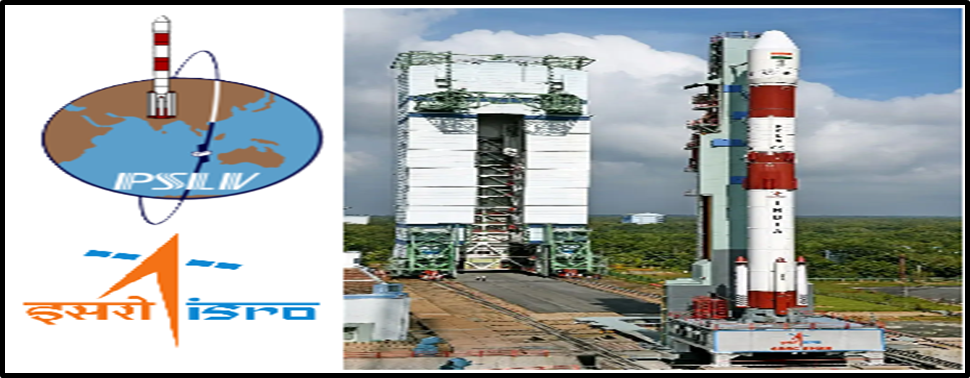
About PSLV
- The Polar Satellite Launch Vehicle (PSLV) is India’s third-generation launch vehicle, designed and operated by ISRO, and operational as the agency’s workhorse since its first successful flight in October 1994.
- It was the first Indian rocket designed with liquid propulsion stages, using alternating solid and liquid fuel across its four stages, standing about 44 metres tall with a lift-off mass of up to 320 tonnes.
Stage-by-Stage Design of PSLV
- Stage 1 (PS1): An S139 solid rocket motor (HTPB propellant), one of the largest solid boosters in the world, augmented by strap-on boosters.
- Stage 2 (PS2): The Vikas liquid engine (UDMH and Nitrogen Tetroxide), providing controlled sustained thrust.
- Stage 3 (PS3): An S7 solid rocket motor (HTPB propellant) delivering a high-velocity boost in the upper atmosphere.
- Stage 4 (PS4): Twin restartable Earth-storable liquid engines (MMH and MON-3) for precise, multi-orbit satellite injection.
Variants and Payload Capacity
- PSLV-CA: Core alone, no strap-on boosters; most cost-effective for lighter payloads.
- PSLV-DL / PSLV-QL: Equipped with two and four strap-on boosters respectively.
- PSLV-XL: The most powerful and most commonly flown configuration, with six extended strap-on boosters.
- Payload Capability: Up to 1,750 kg to Sun-Synchronous Orbit (600 km); up to 3,800 kg to LEO; up to 1,425 kg to sub-GTO.
Landmark Missions
- Chandrayaan-1 (2008): Launched via PSLV-XL; discovered water molecules on the Moon.
- Mars Orbiter Mission / Mangalyaan (2013): India became the first Asian nation to reach Mars orbit, and the first country globally to do so on its maiden attempt.
- PSLV-C37 (2017): Set a then-world-record by deploying 104 satellites in a single mission.
- AstroSat (2015) & Aditya-L1 (2023): India’s first space observatory and first solar observatory respectively.
- PSLV-C58 (2024): Launched XPoSat with the POEM-3 experimental platform aboard the spent upper stage.
- PSLV-C62 (2026): Deployed the EOS-N1 hyperspectral Earth observation satellite for DRDO.
Applications and Recent Developments
- Primary Uses: Earth observation, interplanetary and astronomical missions, commercial rideshare for over 30 countries, and strategic surveillance/ISR support.
- Launch Site: Satish Dhawan Space Centre (SDSC), Sriharikota.
- POEM Platform: The spent fourth stage is repurposed as the PSLV Orbital Experimental Module to host in-orbit experiments instead of becoming debris.
- Recent Anomalies: PSLV-C61 (May 2025) and PSLV-C62 (January 2026) faced technical anomalies during the third-stage (PS3) burn, prompting technical review.
- Historic Success Rate: Approximately 92% across more than 60 missions and 340+ satellites launched.
Conclusion
Operational since 1994, the four-stage PSLV has been ISRO’s most reliable workhorse, enabling landmark missions such as Chandrayaan-1 and the Mars Orbiter Mission, and setting a satellite-deployment record with PSLV-C37 in 2017. Despite recent third-stage anomalies, it retains a historic success rate of about 92%.
| This concept has been elaborately discussed in the following article — ISRO Launches Advanced Earth Observation Satellite EOS-05 |