
Context
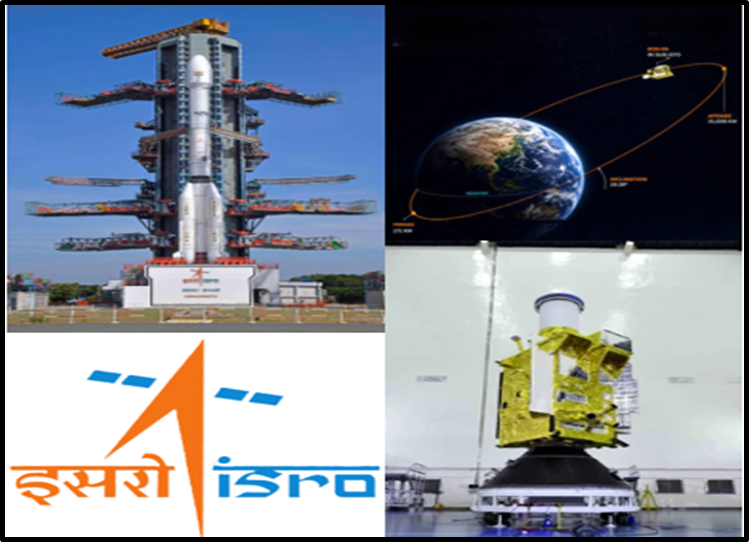
- Recently, the Indian Space Research Organisation (ISRO) launched Earth-observation satellite EOS-05 aboard GSLV-F17 from Satish Dhawan Space Centre, Sriharikota to establish persistent geo-imaging over the Indian subcontinent and adjoining regions.
About EOS-05 Earth Observation Satellite
- First geosynchronous imaging satellite: EOS-05 is India’s first-ever imaging satellite from a geosynchronous orbit (Orbital period equals Earth’s rotation).
- Payload Weight: At 2,367 kg, EOS-05 is the heaviest satellite ever placed into orbit by a GSLV rocket.
- Replaces EOS-03, which was lost in the unsuccessful GSLV-F10 mission (August 2021).
- The satellite is designed to provide near-real-time observation (“Eye in the Sky”) of Earth’s surface.
- Launch Vehicle: GSLV-F17 (3-stage, 51.7-meter-tall rocket with a cryogenic 3rd stage and a lift-off mass of ~420.5 tonnes).
- Multi-Band Imaging: Features advanced optical sensors across visible, infrared, multi-spectral, and hyperspectral bands.
- Mission life: 9 years.
- Applications: Agriculture, disaster management, water resources, forestry and urban planning.
What is Geosynchronous Satellite Launch Vehicle?
- Geosynchronous Satellite Launch Vehicle (GSLV) are Indian rockets developed by ISRO.
- It is primarily designed to launch heavier communication and other satellites into Geosynchronous Transfer Orbit (GTO).
- Three-stage vehicle:
- First stage – Solid-fuel core (S139) with four liquid strap-on boosters
- Second stage – Liquid fuel (Vikas engine)
- Third stage – Cryogenic Upper Stage (CUS) — the most technologically critical part
- Variants:
- GSLV Mk II – Uses the indigenous cryogenic stage; operational since 2014 (after early failures).
- GSLV Mk III (now called LVM3) – A more powerful, next-generation vehicle with a more powerful CE-20 cryogenic engine; used for larger missions like Chandrayaan-2, Chandrayaan-3, and crewed Gaganyaan test flights.
- High-Profile Projects:
- GSLV/LVM3 variants have launched major missions such as Chandrayaan-2, Chandrayaan-3, GSAT, NVS, and OneWeb satellites, and are also designated for Gaganyaan human spaceflight missions.
Key Difference: PSLV vs GSLV
| Feature | PSLV | GSLV Mk II |
| Primary use | Polar, Sun-synchronous & LEO satellites | Geosynchronous Transfer Orbit (GTO) & higher orbits |
| Stages | 4 stages | 3 stages + liquid strap-ons |
| Propulsion | Solid + Liquid stages | Solid + Liquid + Cryogenic |
| Cryogenic engine | No | CE-7.5 |
| Important CTC from this Article for UPSC Prelims What are GSLV? ISRO PSLV |
Q. With reference to the Earth Observation Satellite-05 (EOS-05) recently launched by ISRO, consider the following statements:
1. It is India's first dedicated imaging satellite placed in a geosynchronous orbit (~36,000 km above Earth).
2. The satellite was injected directly into its final geostationary orbit using the Polar Satellite Launch Vehicle (PSLV).
3. It serves as a replacement for the EOS-03 satellite lost during the GSLV-F10 mission.
Which of the statements given above are correct?
(a) 1 and 2 only
(b) 2 and 3 only
(c) 1 and 3 only
(d) 1, 2 and 3
Answer & Explanation
Correct Answer: (c) 1 and 3 only
• Statement 1 is correct: EOS-05 is India's first dedicated imaging satellite designed to monitor the Earth from a geosynchronous orbit (~36,000 km altitude), enabling near real-time persistent monitoring.
• Statement 2 is incorrect: EOS-05 was launched aboard the GSLV-F17 (Geosynchronous Satellite Launch Vehicle), not PSLV. Furthermore, it was injected into a Sub-Geosynchronous Transfer Orbit (Sub-GTO) from where onboard propulsion engines will raise it to its final operational orbit.
• Statement 3 is correct: EOS-05 replaces the EOS-03 satellite, which was lost during the unsuccessful GSLV-F10 mission in August 2021.