
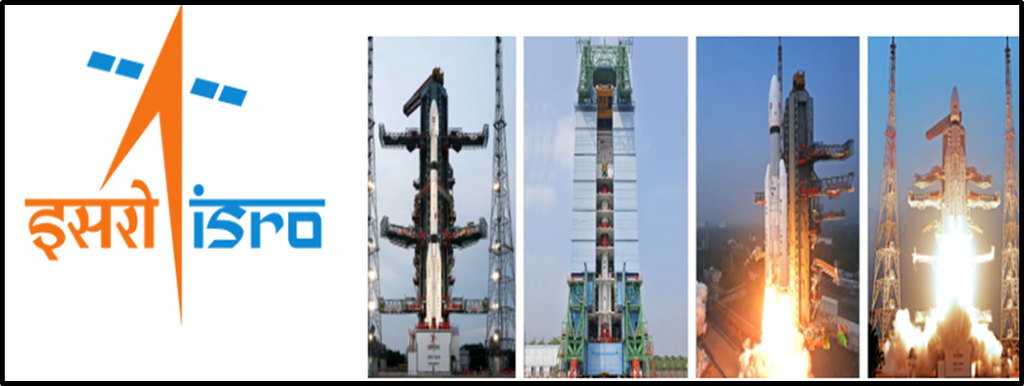
About ISRO
- The Indian National Committee for Space Research (INCOSPAR) was established in 1962 under Dr. Vikram Sarabhai, and ISRO was formed on 15 August 1969; in 1972, it was brought under the Department of Space (DoS).
- Objective: Develop and apply space technology for national needs, including communication, remote sensing, navigation, meteorology and scientific research.
- Head Quater: Bengaluru,Karnataka
- Major Centres: VSSC–Thiruvananthapuram (launch vehicles); URSC–Bengaluru (satellites); SDSC–Sriharikota (launches); LPSC–Valiamala & Bengaluru (propulsion); SAC–Ahmedabad (space applications); NRSC–Hyderabad (remote sensing).
Launch Vehicles and Satellite Systems
- Active Launchers: Polar Satellite Launch Vehicle (PSLV), Geosynchronous Satellite Launch Vehicle (GSLV), heavy-lift LVM3, and Small Satellite Launch Vehicle (SSLV).
- Satellite Constellations: Earth observation (IRS series) and communication (INSAT series) satellite fleets.
- Navigation Systems: Regional navigation system NavIC (officially IRNSS), and the GPS-aided GAGAN system.
Deep-Space and Interplanetary Missions
- Chandrayaan Programme: Chandrayaan-1 (2008) verified water molecules on the Moon; Chandrayaan-2 (2019) orbiter continues lunar mineralogy mapping despite the lander crash; Chandrayaan-3 achieved a safe soft landing near the Moon’s south polar region on 23 August 2023.
- Mars Orbiter Mission (Mangalyaan): Launched 2013, entered Martian orbit on its first attempt in 2014, making India the first nation to achieve this, at a cost of about ₹450 crore.
- Astronomy Observatories: AstroSat (2015), India’s first multi-wavelength space telescope; Aditya-L1 (2023), India’s first solar observatory at the Sun-Earth L1 Lagrange point; XPoSat (2024) for cosmic X-ray polarimetry.
- SpaDeX: In January 2025, ISRO validated indigenous spacecraft docking and undocking using two small satellites.
Human Spaceflight — Gaganyaan Programme
- Mission Profile: Designed to carry up to three astronauts into a 400 km Low Earth Orbit for about three days, followed by a sea splashdown recovery in Indian waters.
- Axiom-4 Precursor: Indian astronaut Shubhanshu Shukla spent 18 days aboard the International Space Station (ISS) in June-July 2025 for microgravity research.
- Launch Cadence: Uncrewed test missions (prefixed G1, G2, G3) precede the first crewed flight, Gaganyaan-4, slated for 2026.
Future Roadmap
- Chandrayaan-4: A lunar sample return mission planned for 2027-2028.
- Venus Orbiter Mission (VOM): Scheduled for March 2028 to study Venus’s atmosphere and surface interactions.
- Bharatiya Antariksh Station (BAS): India’s planned modular space station; first module BAS-01 targeted for 2028, full station operational by 2035.
- Crewed Lunar Landing: ISRO aims to land an Indian astronaut on the Moon by 2040.
Conclusion
Evolving from INCOSPAR (1962) to ISRO in 1969, the agency achieved orbital capability in 1980 and has since delivered cost-efficient interplanetary milestones, including the first-attempt Mars orbit insertion (2014) and the Chandrayaan-3 south-pole landing (2023).
It is now advancing indigenous human spaceflight through Gaganyaan and a long-term roadmap toward the Bharatiya Antariksh Station and a crewed lunar landing by 2040.
| This concept has been elaborately discussed in the following article ISRO Launches Advanced Earth Observation Satellite EOS-05 |