
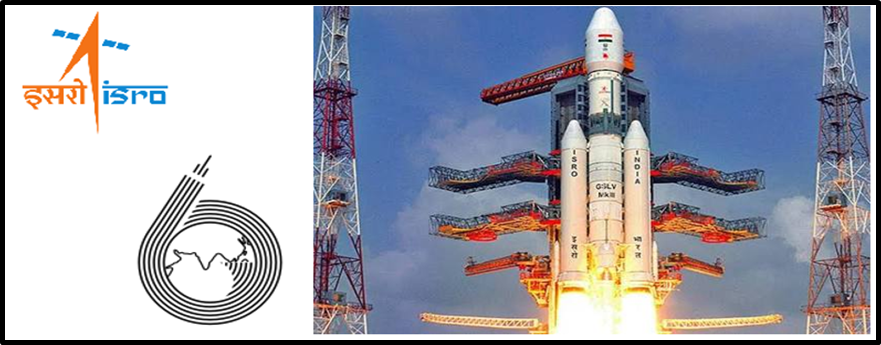
About GSLV
The Geosynchronous Satellite Launch Vehicle (GSLV) is an Indian rocket developed by ISRO to launch satellites into geosynchronous and geostationary orbits. It is a three-stage rocket incorporating a cryogenic upper stage, mainly used to launch heavy communication, weather, and Earth-observation satellites.
Specifications of Geosynchronous Satellite Launch Vehicle(GSLV)
- Developed by: ISRO; designed mainly to launch 2-tonne-class satellites into Geosynchronous Transfer Orbit (GTO).
- Height of the GSLV: About 51.7 m for the current GSLV configuration (GSLV-F14); older standard specifications list about 49 m.
- Lift-off mass: About 420 tonnes for GSLV-F14.
Origins and Development
- Project Genesis: Initiated in 1990 to build an independent 2-tonne class Geostationary Transfer Orbit (GTO) launch capability.
- MTCR Roadblock: In 1992, U.S. intervention under the Missile Technology Control Regime (MTCR) blocked Russia’s Glavkosmos from transferring cryogenic engine technology to India.
- Indigenous Cryogenic Stage: ISRO’s 22-year CUSP project developed the indigenous Cryogenic Upper Stage (CUS), culminating in GSLV-D5’s success in 2014.
Rocket Anatomy and Specifications
- Stage 1 (GS1): Solid core (S139 HTPB motor) with four liquid-fuel strap-on boosters (L40/L40H) powered by Vikas engines.
- Stage 2 (GS2): Liquid core powered by a single high-chamber-pressure Vikas engine.
- Stage 3 (GS3): The Cryogenic Upper Stage (CUS), using liquid hydrogen (LH2 at -253°C) and liquid oxygen (LOX at -183°C).
- Payload Capability: 2,250-2,500 kg to GTO; up to 6,000 kg to Low Earth Orbit.
GSLV Family: Mark I vs Mark II vs LVM3
- GSLV Mark I (Retired): Used Russian-supplied KVD-1 cryogenic engines.
- GSLV Mark II (Active): Propelled by the indigenous CE-7.5 engine using a staged combustion cycle.
- LVM3 (formerly GSLV Mark III): A fundamentally different, much heavier three-stage vehicle using a 200 kN CE-20 gas-generator engine and two S200 solid strap-ons, unlike GSLV’s liquid strap-ons.
Flight Record and Recent Developments
- Early Record: GSLV’s early phase saw a 66.7% failure rate, earning the nickname “Naughty Boy”.
- Post-2014 Turnaround: Achieved a 90.9% launch-vehicle success rate after the indigenous upper stage matured.
- GSLV-F17 / EOS-05 (4 September 2026): ISRO used a sub-GTO orbit deployment to safely launch the 2,367 kg satellite, earning the rocket the nickname “Smart Boy”.
- Retirement Plan: GSLV is excluded from IN-SPACe privatization bids (unlike PSLV, LVM3, SSLV) due to cost and complexity, and is set for retirement after about 5 more missions, handing future payloads to LVM3.
Conclusion
Conceived in 1990 and delayed by the 1992 MTCR cryogenic-technology denial, GSLV achieved indigenous cryogenic capability with GSLV-D5 in 2014, improving its success rate to 90.9%. It remains distinct from the heavier LVM3 and is being phased out in favour of LVM3 for future medium-to-heavy payloads.
| This concept has been elaborately discussed in the following article ISRO Launches Advanced Earth Observation Satellite EOS-05 |