
Context
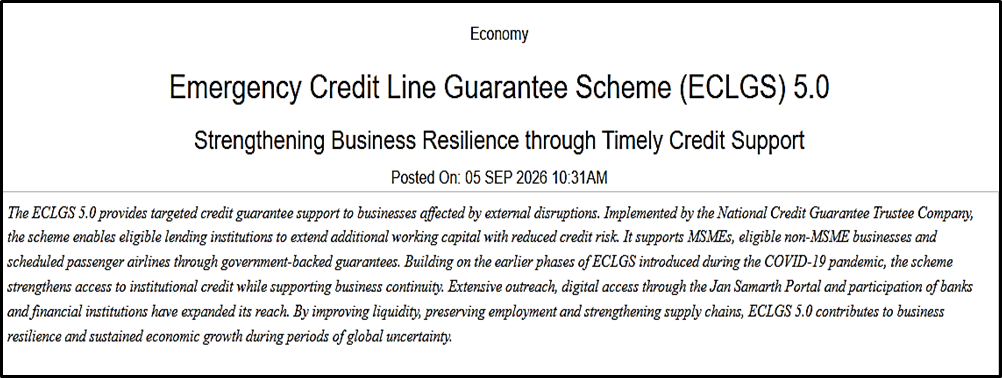
- Amid geopolitical tensions and external economic disruptions affecting supply chains, logistics and business liquidity, the Government approved ECLGS 5.0.
What is ECLGS?
- The Emergency Credit Line Guarantee Scheme (ECLGS) was launched in 2020 under the Aatmanirbhar Bharat Package.
- It was initially introduced to help businesses facing financial stress due to the COVID-19 pandemic.
- The scheme enables lending institutions to provide additional credit backed by government guarantees, thereby reducing their credit risk.
- ECLGS has subsequently evolved through different phases to address the changing needs of businesses and specific sectors.
Evolution of ECLGS
| Phase | Major Coverage / Focus |
| ECLGS 1.0 | MSMEs, business enterprises, Mudra borrowers and individual business loans |
| ECLGS 2.0 | 26 stressed sectors identified by the Kamath Committee and healthcare sector |
| ECLGS 3.0 | Hospitality, travel & tourism, leisure & sporting and civil aviation sectors |
| ECLGS 4.0 | Healthcare infrastructure, including hospitals, nursing homes, clinics, medical colleges and manufacturers of liquid oxygen/oxygen cylinders |
| ECLGS 5.0 | MSMEs, eligible non-MSME businesses and scheduled passenger airlines affected by external disruptions |
Salient Features of ECLGS 5.0
- Operational period: Until 31 March 2027, or until guarantees of ₹2.55 lakh crore are issued, whichever is earlier.
- Eligible beneficiaries:
- MSMEs across sectors.
- Eligible non-MSME business borrowers.
- Scheduled passenger airlines.
- Lending institutions: Scheduled Commercial Banks, Scheduled Urban Co-operative Banks, Financial Institutions and eligible NBFCs.
- Sectors Excluded from ECLGS 5.0
- Non-Banking Financial Companies (NBFCs)
- Power sector – Generation, transmission and distribution
- Telecom service providers
- Sugar and ethanol
- Information Technology (IT) companies
- Paper and paper products
- Educational institutions
- Beverages, except tea and coffee
- Tobacco
For MSMEs and Eligible Non-MSMEs
- Borrowers must have existing working capital facilities from Member Lending Institutions (MLIs) as on 31 March 2026.
- Loan repayments should not have been overdue by more than 60 days.
- Borrowers who have already availed additional credit under the Credit Guarantee Scheme for Exporters (CGSE) are excluded up to the amount already availed under CGSE.
- Credit guarantee coverage:
- MSMEs → 100%
- Eligible non-MSMEs → 90%
- Additional credit: Up to 20% of peak fund-based working capital outstanding during Q4 FY 2025–26.
- Maximum: ₹100 crore per borrower.
- Guarantee fee: No guarantee fee payable by MLIs.
Interest Rate and Loan Tenure
- MSMEs: Interest linked to External Benchmark Lending Rate (EBLR).
- Non-MSMEs: Interest linked to Marginal Cost of Funds-based Lending Rate (MCLR).
- Lending institutions may charge up to 0.75% above the benchmark, subject to an overall ceiling of 9% per annum.
- For eligible NBFCs, interest rate cannot exceed 13% per annum.
- Loan tenure: 5 years, including a 1-year moratorium.
Conclusion
ECLGS 5.0 seeks to provide timely, government-backed liquidity support to viable businesses facing external disruptions, thereby strengthening credit access, business resilience, employment and economic continuity. By extending coverage beyond MSMEs to eligible non-MSMEs and airlines, the scheme aims to cushion the economy against external shocks while promoting financial stability.
| Important CTC from this article – Emergency Credit Line Guarantee Scheme |