
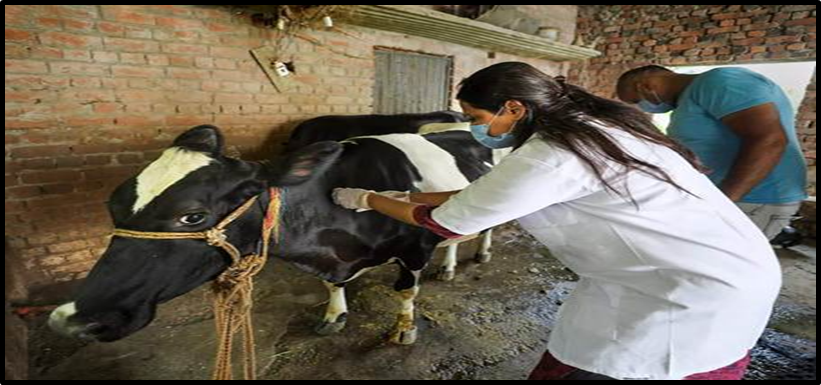
About Lumpy Skin Disease
- Definition: An acute-to-chronic, transboundary viral infection primarily affecting cattle and water buffalo, and occasionally wild ruminants.
- Causative Agent: The Lumpy Skin Disease Virus (LSDV), a double-stranded DNA virus of the genus Capripoxvirus (family Poxviridae), sharing over 80% genomic homology with sheeppox and goatpox viruses.
- Zoonotic Status: Host-specific to ruminants and strictly non-zoonotic — it poses no threat to human health or food safety.
- Susceptibility: European Bos taurus breeds are generally more susceptible to severe disease than indigenous Bos indicus breeds.
Clinical Manifestations & Diagnosis
- Symptoms: Fever, lymphadenopathy (prescapular and precrural lymph nodes), lachrymation, nasal discharge, and hypersalivation, followed by firm, painful cutaneous nodules (0.5-5 cm) that can extend to gastrointestinal, respiratory, and genital mucous membranes.
- Severe Pathology: Deep tissue necrosis forming sloughing “sitfast” scabs and ulcerative wounds prone to secondary infection; histopathology shows epidermal hyperplasia, dermal necrosis, and vasculitis.
- Diagnosis: Confirmed via real-time PCR (targeting genes such as partial P32), virus isolation, and immunohistochemistry; differentiated from pseudo-LSD (bovine herpesvirus 2), demodicosis, dermatophilosis, and urticaria.
Transmission & Spread
- Vectors: Mechanically transmitted by hematophagous arthropods, including biting flies, Culex and Aedes mosquitoes, and Rhipicephalus ticks.
- Other Routes: Infected secretions, milk transfer to calves, intrauterine infection, contaminated semen, and fomites.
- Geographic Spread: Historically confined to sub-Saharan Africa, now present across the Middle East, Russia, the Indian subcontinent (including India and Bangladesh), East/Southeast Asia, and recently southern Europe (Italy, France, Spain).
- Economic Impact: Causes losses through reduced milk yield, emaciation, hide damage, reproductive impairment, trade restrictions, and mortality.
Vaccination & Control
- Strategy: Vaccination is the most effective control tool, applied alongside biosecurity measures, vector control, quarantine, and movement restrictions, targeting ≥80% coverage.
- Vaccines: Homologous live attenuated vaccines based on Neethling-type strains (OBP, Lumpyvax, Kenyavac, Herbivac, MCI); heterologous vaccines (Gorgan GTPV strain) are used where sheeppox or goatpox co-exist.
- Side Effects: Vaccination can occasionally cause transient local swelling or a mild “Neethling response” of small post-vaccinal lesions.
Conclusion
Lumpy Skin Disease is an economically significant, non-zoonotic viral disease of cattle and buffalo whose control rests primarily on wide-coverage vaccination combined with vector management and movement restrictions.
| This concept has been elaborately discussed in the following article – Lumpy Skin Disease (LSD) |