
After Reading This Article You Can Solve This UPSC Model Mains Question:
“The challenge for India is not to choose between confrontation and cooperation with China, but to manage competition while safeguarding its strategic interests.” Examine. 15 marks (GS2, International Relation)
CONTEXT
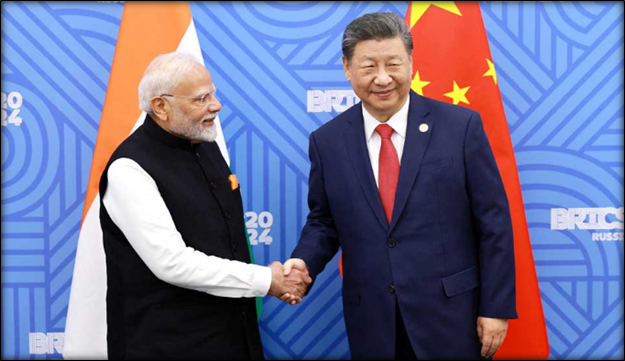
Chinese President Xi Jinping’s India visit after seven years, ostensibly for the BRICS Summit, assumes wider significance amid post-2020 LAC stabilisation, persistent strategic distrust, China–Pakistan convergence, trade asymmetry and competing visions of BRICS.
INTRODUCTION
Xi Jinping’s visit presents India with a delicate diplomatic opportunity: stabilise India–China relations without compromising national security, while ensuring that BRICS remains an inclusive Global South platform rather than becoming an anti-Western or China-dominated bloc.
Why XI Jinping’s visit is significant for India
1. First India visit after seven years
- Xi’s visit marks his first visit to India since 2019, making it diplomatically significant after bilateral relations deteriorated sharply following the 2020 eastern Ladakh crisis.
- The visit provides an opportunity to assess whether cautious normalisation can progress towards sustainable stabilisation in India–China relations.
2. Opportunity to consolidate post-2020 normalisation
Recent bilateral steps indicate limited improvement in relations:
- Resumption of direct flights can restore economic, tourism and people-to-people connectivity that was disrupted during the period of heightened tensions.
- Resumption of the Kailash Mansarovar Yatra can revive an important civilisational and religious dimension of India–China relations.
3. Opportunity to restore strategic communication
- Xi’s visit can provide an opportunity for both leaderships to establish clear political communication channels to prevent bilateral disagreements from escalating into military crises.
- Regular political, diplomatic and military-level dialogue can help rebuild minimum strategic trust that was severely weakened after 2020.
4. Reinforcing peace and tranquillity along the LAC
- The visit can strengthen the understanding that peace and tranquillity along the border are essential for the overall development of bilateral relations.
- India can use the engagement to push for continued implementation of existing border-management mechanisms and greater predictability in military deployments.
Challenges in India–China relations
1. Unresolved Boundary Dispute and LAC Tensions
- The unresolved boundary question remains the central structural challenge, with periodic standoffs and differing perceptions of the LAC continuing to create instability.
- The legacy of Depsang, Chumar, Doklam and the 2020 eastern Ladakh crisis demonstrates the persistent vulnerability of the border to military confrontation.
2. Erosion of Strategic and Political Trust
- The 2020 Galwan crisis severely damaged the political and strategic trust that had developed through earlier bilateral engagement.
- India increasingly evaluates Chinese economic and diplomatic initiatives through a security lens, making comprehensive normalisation difficult.
3. Growing Chinese Economic, Military and Technological Power
- China’s transformation from an emerging economy into a major global power has created a significant power asymmetry between the two countries.
- China’s economic strength, military modernisation, technological capabilities and diplomatic outreach have increased its ability to shape the regional and global strategic environment.
4. Increasing Chinese Assertiveness in the Neighbourhood
- China’s assertive behaviour in the South China Sea, Indo-Pacific, Taiwan Strait and along the India–China border reflects its expanding geopolitical ambitions.
- Its growing economic and strategic presence in South Asia also challenges India’s traditional influence in its neighbourhood.
5. China–Pakistan Strategic Nexus
- China’s close defence, economic and strategic partnership with Pakistan adds another layer of complexity to India’s security environment.
- Projects such as the China–Pakistan Economic Corridor (CPEC) and China’s broader strategic engagement with Pakistan have implications for India’s territorial and security interests.
Recent steps taken to improve India–China bilateral relations
- Border disengagement and restoration of peace along the LAC:
Following the October 2024 patrolling arrangement, both sides completed disengagement at key friction points and have since worked through military and diplomatic mechanisms to maintain peace and tranquillity along the border, creating conditions for broader normalisation. - Strengthening border-management mechanisms:
In the 25th Special Representatives’ talks in August 2026, India and China agreed to establish additional military meeting points and hotline channels in the Eastern and Middle sectors, thereby improving crisis communication and reducing the risk of unintended escalation. - Resumption of direct air connectivity and visa facilitation:
Both countries have taken steps to restore direct flights and facilitate visas, with direct air services resuming from October 2025 and further connectivity being expanded in 2026. This aims to revive business, tourism, academic and people-to-people exchanges. - Revival of people-to-people and religious exchanges:
The Kailash Mansarovar Yatra resumed in 2025 after nearly five years, continued in 2026, and the two sides have also reopened designated border trading points. These measures seek to rebuild societal confidence alongside diplomatic normalisation. - Renewed economic and strategic dialogue:
India and China have resumed functional dialogues on trade, investment and economic issues, while recent discussions have focused on market access, trade imbalance, supply-chain predictability and investment barriers. This reflects an attempt to pursue economic engagement without compromising national-security concerns.
Opportunities BRICS creates for India–China relations
- Provides a platform for strategic dialogue and trust-building:
BRICS enables regular India–China engagement, helping manage the trust deficit and prevent bilateral tensions from escalating. - Promotes issue-based cooperation:
Both countries can cooperate on Global South concerns, including climate change, energy security, development finance and multilateral reforms, despite bilateral differences. - Helps India manage Chinese influence:
India can work with other BRICS members to prevent Chinese dominance and promote BRICS as a non-Western rather than anti-Western platform, consistent with strategic autonomy. - Creates scope for economic and geopolitical engagement:
BRICS provides opportunities for cooperation on trade, supply chains, investment and global economic governance, while allowing India and China to maintain their wider strategic partnerships.
Way forward
1. Make border peace the foundation of normalisation
India should insist that peace and tranquillity along the LAC remain the prerequisite for sustained improvement in bilateral relations.
2. Move beyond disengagement
The next phase should focus on:
Disengagement → De-escalation → De-induction → Long-term boundary management
rather than treating disengagement from individual friction points as the final objective.
3. Strengthen confidence-building mechanisms
- Regular military commander-level dialogue.
- Diplomatic consultations.
- Functional hotlines.
- Border-management mechanisms.
- Greater transparency regarding military activities.
These can reduce the probability of accidental escalation.
4. Continue boundary negotiations
India should continue negotiations through established mechanisms while recognising that final boundary settlement may remain a long-term objective.
5. Correct economic asymmetry
India should simultaneously pursue:
Export competitiveness + domestic manufacturing + reciprocal market access + supply-chain diversification.
Conclusion
Xi Jinping’s visit offers a window for cautious stabilisation, not strategic convergence. India must combine border vigilance with selective cooperation, while shaping BRICS as an inclusive Global South platform and preserving strategic autonomy through diversified global partnerships.
| Important Current To Concept for UPSC : Line of Actual Control (LAC)The BRICS summit |