
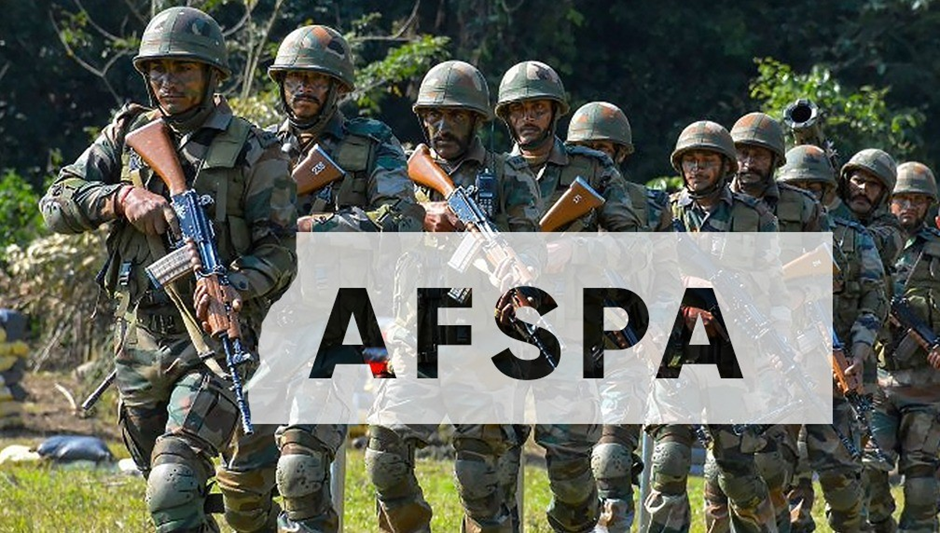
Human rights activists constantly highlight the fact that the Armed forces (Special Powers) Act, 1958 (AFSPA) is a draconian act leading to cases of human rights abuses by security forces. What sections of AFSPA are opposed by the activists? Critically evaluate the requirement with reference to the view held by the Apex Court 15 Marks (GS 3,Internal Security)
Context
The Union Ministry of Home Affairs (MHA) recently extended the Armed Forces (Special Powers) Act, 1958 (AFSPA) in parts of Manipur, Nagaland, and Arunachal Pradesh for six months starting October 1, 2026. This highlights persistent internal security challenges in the Northeast and reignites debates over military authority versus civilian rights.
Introduction
AFSPA grants extraordinary powers to the armed forces in designated conflict zones. While security agencies deem it an indispensable operational shield against terrorism, civil society heavily criticizes the law for enabling human rights abuses, eroding state autonomy, and undermining democratic accountability.
What is AFSPA?
It is a specialized legislative framework that empowers military and paramilitary forces with vast authority to restore and uphold public order. It is deployed exclusively in regions formally labelled as “disturbed” due to severe internal security threats that overwhelm local law enforcement capacities.
AFSPA Historical Background
- Colonial Origins: The core concept was originally conceived by British authorities under Viceroy Linlithgow to violently suppress the ‘Quit India’ movement.
- Post-Independence Enactment: Its modern legislative roots trace back to a 1948 ordinance, which was subsequently passed as the Armed Forces (Assam and Manipur) Special Powers Act in 1958 to counter the escalating Naga insurgency.
- Regional Variants: Subsequent iterations were enacted to address specific regional militancies, including the Armed Forces (Punjab and Chandigarh) Special Powers Act, 1983 (later withdrawn), and the Armed Forces (Jammu and Kashmir) Special Powers Act, 1990, which remains active today.
Armed Forces Special Power Act Key Provisions
- ‘Disturbed Area’ Declaration: Under Section 3, a State Governor, Union Territory Administrator, or the Central Government has the authority to officially designate a region as disturbed.
- Extraordinary Authority: Personnel are legally permitted to use lethal force against individuals violating prohibitory orders, destroy fortified insurgent shelters, and conduct arrests and property searches without a judicial warrant.
- Legal Immunity: Security personnel receive near-absolute legal protection under the Act. No prosecution or civil suit can be initiated against them for official actions without the prior, explicit sanction of the Central Government.
The Current Footprint of AFSPA
- Manipur: The entire state remains disturbed (excluding 13 Valley police stations). Following the May 2023 ethnic conflict, the MHA unilaterally restored the Act in several areas, overriding the State Government’s request for a withdrawal in the public interest.
- Nagaland & Arunachal Pradesh: The Act is retained in specific districts due to active insurgent groups and the unresolved Naga political peace process involving factions like the NSCN-IM.
- Revocations: The law has been successfully and fully repealed in Mizoram, Tripura (2015), and Meghalaya (2018).
Supreme Court on AFSPA
- Constitutional Validity: In the 1998 Naga People’s Movement vs. Union of India case, the Court upheld the Act but mandated strict six-month reviews of the ‘disturbed area’ status and emphasized the use of minimum necessary force.
- Proportionality Doctrine: A landmark July 2016 ruling directed that armed forces must not use excessive or retaliatory force even in AFSPA-imposed regions, reinforcing human rights protections.
- Judicial Oversight: In July 2017, overruling Central objections, the Court ordered a CBI Special Investigation Team (SIT) to probe alleged fake encounters in Manipur, breaking the absolute shield of military immunity.
Significance of AFSPA
- Counter-Insurgency Edge: Facilitates swift, intelligence-led operations against terrorism without standard civilian procedural delays.
- Border Security: Critical for countering cross-border terrorism, arms smuggling, and militant infiltration in geopolitically volatile frontiers.
- Institutional Shield: Protects soldiers operating in high-stress, hostile zones from frivolous, retaliatory litigation, allowing decisive action.
- Administrative Support: Restores public order in regions where local police forces are compromised or overwhelmed by armed militants.
Challenges and Criticisms
- Human Rights Violations: The Act is consistently linked to severe allegations of extrajudicial killings and torture.
- Erosion of Accountability: The stringent requirement for Central prosecution sanction has resulted in abysmal conviction rates, fostering a perceived culture of impunity.
- Alienation and Trauma: Prolonged military presence and sweeps cause deep-seated psychological distress among civilians, frequently pushing disenfranchised youth toward extremism.
- Federal Friction: Unilateral impositions by the MHA undermine the principles of cooperative federalism and side-line local civilian governance.
Way Forward
- Align with Constitutional Safeguards: Mandate strict military compliance with Article 22, ensuring arrested individuals are presented before a civilian magistrate within 24 hours of detention.
- Establish Scientific Criteria: Develop a transparent, evidence-based methodology in consultation with states to objectively determine when an area qualifies for ‘disturbed’ status.
- Strengthen Civilian Oversight: Empower independent human rights commissions to transparently investigate complaints of excesses without requiring prior central sanction.
- Adopt Committee Recommendations: Seriously evaluate the recommendations of the Justice Jeevan Reddy Committee and the Second Administrative Reforms Commission (ARC), which advocated for the sweeping overhaul or repeal of AFSPA to align with democratic norms.
- Foster Cooperative Federalism: Ensure State Governments are active, consensual partners in the declaration or revocation of ‘disturbed area’ status.
Conclusion
While robust military capability is vital for securing India’s volatile borders, AFSPA in its current form remains a severe democratic anomaly. Achieving lasting peace requires moving beyond draconian legal shields, prioritizing cooperative federalism, institutional accountability, and fundamental human rights to ensure the state does not alienate the citizens it seeks to protect.
| Important Current to Concept (CTC) from this Article for UPSC : 1. Armed Forces (Special Powers) Act 2.Ministry of home Affairs |