
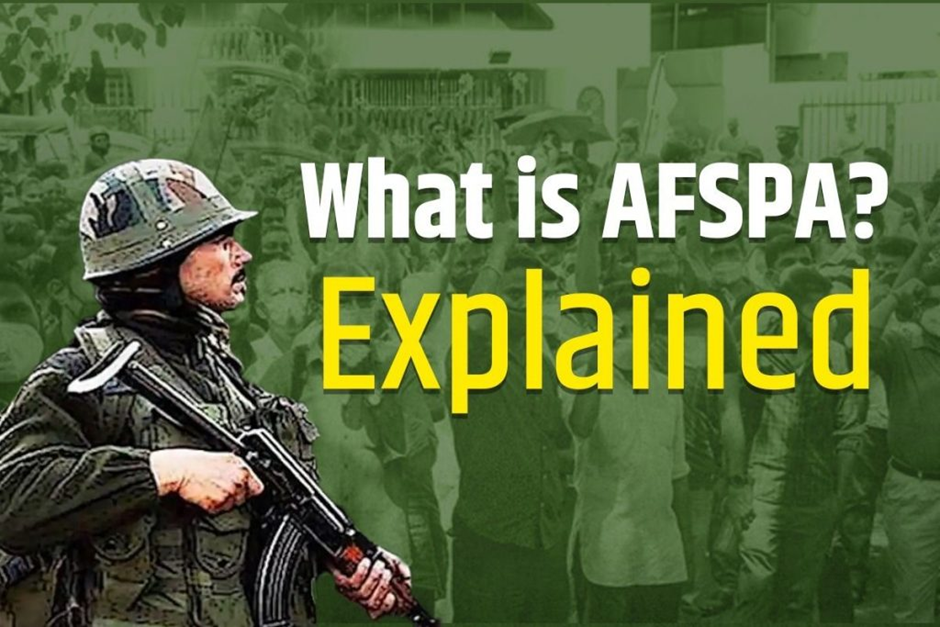
About AFSPA
The Armed Forces (Special Powers) Act, 1958 (AFSPA) is a specialized counter-insurgency legislation enacted to combat severe internal security threats across India’s volatile frontiers. The law equips military personnel with extraordinary operational authority to neutralize armed rebellions, continuously sparking intense debates over the balance between national security and human rights.
Overview of AFSPA, 1958
- Objective: Empowers armed forces to restore public order in officially designated “disturbed areas.”
- Status: Active in J&K (under the 1990 Act) and parts of Nagaland, Assam, Manipur, and Arunachal Pradesh.
Key Statutory Provisions
- Section 3 (Disturbed Area Declaration): The Central Government, State Governor, or UT Administrator can declare an area “disturbed” to deploy armed forces.
- Section 4 (Special Powers): Grants personnel the authority to use lethal force against lawbreakers, arrest and search without judicial warrants, prohibit assemblies of five or more people, and destroy insurgent camps.
- Section 5 (Treatment of Detainees): Arrested individuals must be transferred to the nearest police station with the “least possible delay.”
- Section 6 (Legal Immunity): Shields armed forces personnel from prosecution or civil suits without prior explicit sanction from the Central Government.
Landmark Judicial Judgments
- Naga People’s Movement v. Union of India (1997): Upheld the constitutional validity of AFSPA but mandated periodic status reviews and the strict use of minimum necessary force.
- Extra Judicial Execution Victim Families Association(EEVFAM) v. Union of India (2016): Ruled that Section 6 immunity is not absolute, mandating mandatory investigations into alleged fake encounters and excessive force.
- Sebastian M. Hongray v. Union of India (1984): Established that security personnel can still be held legally accountable for custodial abuses despite statutory immunities.
Conclusion
AFSPA provides critical operational cover for armed forces in high-risk conflict zones, yet its sweeping immunities frequently challenge democratic accountability. Strict judicial oversight remains essential to balance national security imperatives with fundamental human rights protections.
| This concept has been elaborately discussed in the following article – AFSPA Extensions: A Persistent Necessity or a Democratic Anomaly? |