
After Reading This Article You Can Solve This UPSC Mains Model Question:
Evaluate the relevance of India’s ‘No First Use’ (NFU) policy and its integration into global nuclear regimes amid emerging geopolitical and technological shifts. 15 Marks (GS 3 Internal Security)
Context
India’s nuclear doctrine, operationalised in 2003, faces renewed scrutiny as the global security environment shifts towards a multipolar system, marked by disruptive technologies and a deeper China-Pakistan strategic alignment.
Introduction
A nuclear doctrine guides the peacetime and wartime employment of nuclear assets. While India’s framework has established it as a responsible nuclear power, updating it to address mid-2020s security challenges is critical for maintaining credible deterrence and strategic stability.
Historical Evolution of India’s Nuclear Posture
- Early Initiatives: Spearheaded by Homi J. Bhabha in the 1940s, the program became a strategic necessity following the 1964 Chinese nuclear tests.
- Strategic Milestones: The 1974 Pokhran-I and 1998 Pokhran-II tests established India as a nuclear weapons state, prompting the 1999 Draft Nuclear Doctrine after the Kargil conflict.
Core Principles of the 2003 Nuclear Doctrine
- Nuclear Command Authority (NCA): The sole body authorizing nuclear use, ensuring absolute civilian political control via an Executive Council and a Prime Minister-led Political Council.
- Credible Minimum Deterrence (CMD): A non-aggressive posture ensuring a second-strike capability without engaging in an arms race or restricting nuclear R&D.
- No First Use (NFU) & Massive Retaliation: A pledge to use nuclear weapons only in retaliation to a first strike (or major biological/chemical attacks), designed to inflict unacceptable damage.
The Nuclear Triad: Backbone of Deterrence
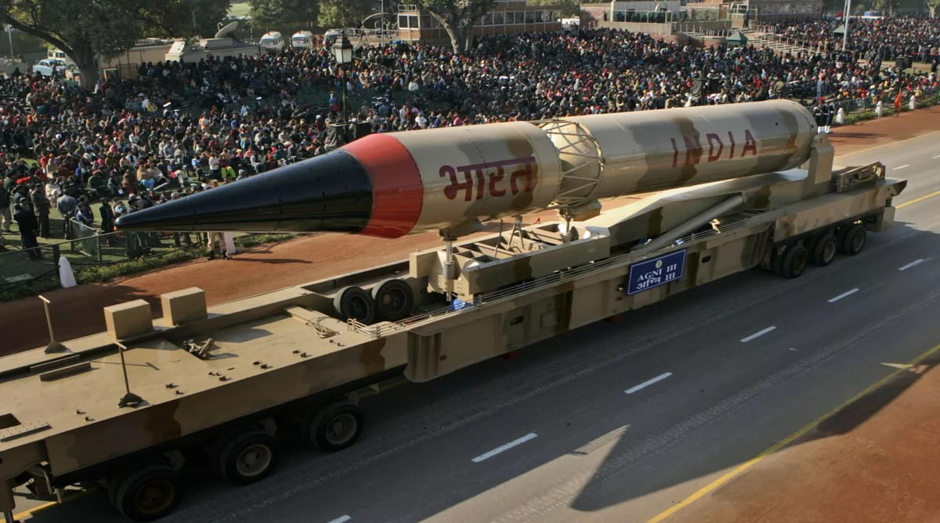
- Land: Comprises the Agni series (Agni-II, Agni-IV, and ICBM Agni-V) ballistic missiles.
- Air: Delivered by modified strategic bombers like Sukhoi Su-30MKIs, Mirage 2000s, and Jaguars.
- Sea: Anchored by the 6,000-tonne INS Arihant, providing a highly survivable maritime strike capability that secures the second-strike architecture.
India’s Stance on Global Nuclear Regimes
- Nuclear Non-Proliferation Treaty (NPT): India refuses to sign the 1968 treaty, criticizing it as discriminatory for dividing the world into “nuclear haves” and “have-nots”.
- Nuclear Suppliers Group (NSG) Deadlock: Despite US support, China blocks India’s NSG membership, citing its NPT non-signatory status, while pushing for Pakistan’s parallel entry.
Strategic Significance of India’s Nuclear Restraint
- Economic Prudence: NFU avoids the financial burden of maintaining a hair-trigger first-use nuclear infrastructure.
- Moral High Ground: By pledging restraint, India places the moral responsibility of nuclear escalation entirely on the adversary.
- Global Mainstream Integration: The doctrine legitimized India as a responsible power, facilitating entry into the MTCR, Wassenaar Arrangement, and Australia Group.
- Strategic Stability: The predictable doctrine has provided diplomatic continuity for over two decades.
- Prevention of Arms Race: The CMD principle ensures defense without triggering an indefinite expansion of regional arsenals.
Key Challenges Confronting India’s Nuclear Strategy
- Two-Front Synchronized Threat: A deepening China-Pakistan strategic nexus poses interconnected deterrence challenges not anticipated in 2003.
- The Tactical Dilemma: Pakistan’s deployment of Tactical Nuclear Weapons (TNWs) complicates India’s massive retaliation posture during localized conflicts.
- Technological Disruptions: Artificial Intelligence, cyber capabilities, and hypersonic weapons compress decision-making timelines and threaten command-and-control networks.
- Untested Crisis Management: An NFU posture demands extreme institutional confidence to absorb a first strike and orchestrate retaliation—a capability that remains operationally untested.
- Trust Deficit in NFU: Adversaries do not inherently trust NFU pledges, leading to identical peacetime weapon deployments regardless of declaratory policy.
Strategic Way Forward to Modernize India’s Deterrence
- Clarify Operational Redlines: Retain NFU advantages while eliminating ambiguity regarding responses to tactical, biological, or chemical threats.
- Fortify the Maritime Leg: Accelerate SSBN (nuclear submarine) programs to ensure continuous deterrent patrols and absolute survivability.
- Harden Command Networks: Invest in cyber resilience and space-based early warning systems to protect the Nuclear Command Authority.
- Establish Risk Reduction Channels: Negotiate dedicated bilateral crisis communication arrangements with China, mirroring protocols with Pakistan.
- Increase Posture Legibility: Issue periodic unclassified statements on force posture to enhance deterrent credibility without disclosing targets.
- Sustain NSG Diplomacy: Leverage civil nuclear agreements to build global consensus for NSG membership, isolating single-nation blockades.
Conclusion
India’s nuclear doctrine remains a formidable instrument for balancing regional deterrence with global integration. Preserving its efficacy relies on modernizing triad capabilities and reinforcing strategic autonomy amidst a rapidly evolving, multi-polar global nuclear order.
| Important Current to Concept (CTC) from this Article for UPSC : 1. Nuclear Suppliers Group 2. Treaty on the Non-Proliferation of Nuclear Weapons (NPT) |