
Context
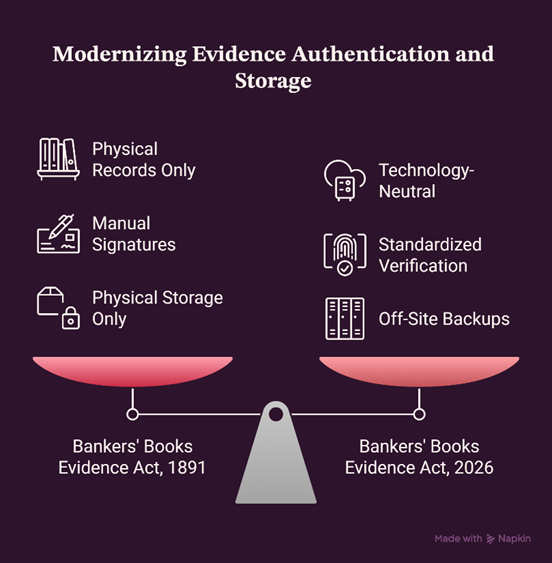
- Recently, the Bankers’ Books Evidence Act, 2026 received the assent of the President on 13th August 2026, replacing the Bankers’ Books Evidence Act, 1891 and providing a modern framework for the use of banking records as evidence in line with contemporary banking practices.
Objective of the Act
- To modernise the legal framework governing the use of banking records as evidence in legal proceedings.
- To align banking evidentiary law with contemporary banking practices and technology.
- To promote ease of doing business by simplifying certification processes.
Key Features of the Act
- Electronic/Digital Records
- Recognises electronic and digital records of bankers’ books as admissible, valid, and legally enforceable evidence, subject to prescribed conditions.
- Ensures the authenticity, accuracy, integrity, and security of electronic records by requiring safeguards against unauthorised changes and tampering.
- Simplified Certification: Provides standardised certification of banking records through manual, digital or electronic signatures.
- Safeguards on Summoning Bank Officials
- Where the bank is not a party to proceedings, courts must record a “special cause” in writing before summoning bank officials.
Intended to reduce unnecessary harassment of banking staff in litigation unrelated to the bank directly.
- Extension to Financial Sector
- Empowers the Central Government to extend the provisions to other financial-sector entities or classes of entities through notification.
- Allows the Government to prescribe conditions, exceptions, or modifications while extending the provisions.
Conclusion
The Bankers’ Books Evidence Act, 2026 represents a shift from a colonial-era, traditional banking-record framework to a modern, technology-neutral evidentiary regime. By recognising digital and cloud-based records, simplifying certification and clarifying procedural requirements, the Act seeks to strengthen the reliability of banking evidence, improve ease of doing business and align financial law with technological advancements.
| Important CTC from this article: Bankers’ Books Evidence Act, 2026 |