
Context
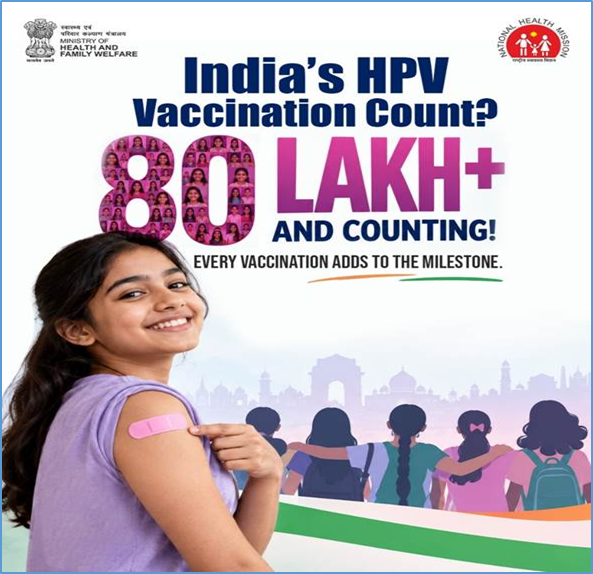
- India achieved a major public health milestone by administering over 80 Lakh (8 million) doses of the Human Papillomavirus (HPV) vaccine under the National HPV Vaccination Campaign within seven months of its rollout.
About National HPV Vaccination Campaign
- Launch & Nodal Ministry: Launched in February 2026; implemented by the Ministry of Health and Family Welfare (MoHFW).
- Target Beneficiaries: 14-year-old adolescent girls.
- Annual Cohort Size: Approximately 1.2 crore (12 million) girls annually, based on Registrar General of India (RGI) 2021 estimates.
- Delivery Protocol: Voluntary, free-of-cost single-dose vaccination with mandatory parental consent, delivered at Government health facilities.
State-Wise Coverage Highlights
- 100% Coverage Achieved: Gujarat, Uttar Pradesh, Madhya Pradesh, and Mizoram.
- More than 90% Coverage Achieved: Bihar, Andhra Pradesh, and Assam.
- Highest Absolute Volume: Uttar Pradesh leads nationwide with over 22 Lakh adolescent girls vaccinated.
Monitoring Mechanism
- U-WIN Platform: Enables real-time district-level vaccination monitoring, identifies coverage gaps/missed beneficiaries, and supports resource allocation.
- AEFI (Adverse Events Following Immunization) Management: Ensures post-vaccination safety through trained Medical Officers and 24×7 referral hospital linkages for managing severe reactions, strengthening public trust and addressing vaccine hesitancy.
- Community Engagement: ASHAs, ANMs, teachers, pediatricians, gynecologists and AIIMS experts help address vaccine hesitancy and misinformation.
About HPV
- Types: Human Papillomavirus (HPV) is a group of over 200 related non-enveloped DNA viruses.
- Primary Types: HPV 16 and HPV 18 (responsible for ~70% of cervical cancers globally).
- Genetic Material: Double-stranded circular DNA enclosed within an icosahedral protein capsid (composed mainly of L1 and L2 proteins).
- Transmission: Direct skin-to-skin contact, primarily sexual contact (vaginal, anal, or oral).
- Prevention: HPV vaccination is highly effective when administered before exposure to the virus (ideally between ages 9–14).
- Major Cancers: HPV is strongly associated with cervical cancer and also contributes to cancers of the anus, penis, vulva, vagina and oropharynx.
- Types of Vaccines:
- Gardasil 9: Nonavalent vaccine covering types 6, 11, 16, 18, 31, 33, 45, 52, and 58.
- Cervavac: India’s indigenous quadrivalent HPV vaccine developed by the Serum Institute of India (SII) covering types 6, 11, 16, and 18.
| Important Current to Concept (CTC) from this Article for UPSC HPV |
Q. With reference to the National HPV Vaccination Campaign and cervical cancer in India, consider the following statements:
1. The National HPV Vaccination Campaign targets 14-year-old adolescent girls for a voluntary, single-dose vaccination at government health facilities.
2. The campaign utilizes the Co-WIN platform for district-level tracking of vaccination coverage and missed beneficiaries.
3. Cervical cancer is primarily caused by persistent infection with high-risk human papillomavirus (HPV) types 16 and 18.
4. Madhya  Pradesh has recorded the highest absolute number of adolescent girls vaccinated under the national campaign.
Which of the statements given above are correct?
(a) 1, 2, and 3 only
(b) 1, 3 only
(c) 2 and 4 only
(d) 1, 2, 3, and 4
Answer: (b) 1, 3 only
Explanation:
• Statement 1 is correct: The campaign provides voluntary, free-of-cost single-dose HPV vaccination to 14-year-old adolescent girls with parental consent at government facilities.
• Statement 2 is incorrect: The campaign leverages the U-WIN platform (dedicated to universal immunization), not the Co-WIN platform (which was developed specifically for COVID-19 vaccination tracking).
• Statement 3 is correct: Over 80% of cervical cancer cases in India are caused by persistent infection with oncogenic HPV types 16 and 18.
• Statement 4 is incorrect: Among all States and UTs, Uttar Pradesh leads in absolute numbers, having vaccinated over 22 Lakh adolescent girls.