
Context
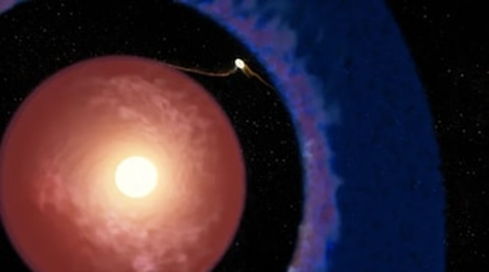
- Astronomers have confirmed Elias 2-24 b, a gas-giant exoplanet that is less than one million years old, making it the youngest known planet discovered so far. The confirmation was made using NASA-funded archival observations from the W. M. Keck Observatory.
About Elias 2-24 b
- Elias 2-24 b is a Jupiter-mass, gas-giant exoplanet orbiting the young star Elias 2-24, located around 450 light-years from Earth in a star-forming region.
- It is still embedded in the natal circumstellar disk of gas and dust and is believed to be actively accumulating material as it forms.
- Youngest known planet: Less than 1 million years old, compared with the previous record holders around PDS 70 and WISPIT 2, which are more than 5 million years old.
- Wide orbit: It lies about 55 Astronomical Units (AU) from its host star – 55 times the average Earth–Sun distance.
- Still forming: The planet is located within a prominent gap in the circumstellar disk, where it is actively accreting gas and dust.
How was it detected?
- ALMA first detected a gap in the dusty disk around Elias 2-24, while the VLT identified a faint object within it.
- Archival Keck Observatory images from 2018–2020 confirmed the object’s movement, establishing it as a planet.
- Coronagraphic Detection: Detected using high-contrast coronagraphy, which blocks the intense glare of the host star and enables the detection of faint infrared signatures in archival images captured between 2018 and 2020.
Future observations
- NASA’s Nancy Grace Roman Space Telescope, with its advanced coronagraph, will improve the detection of young and distant exoplanets hidden by stellar glare.
| Important Current to Concept (CTC) from this article for UPSC: W. M. Keck Observatory. |
Q. With reference to Elias 2-24 b, consider the following statements:
1. It is located in a star-forming region.
2. It is situated within a circumstellar disk of gas and dust.
3. It is approximately 55 light-years from Earth.
4. It is believed to be still undergoing planetary formation.
Which of the statements given above are correct?
A. 1, 2 and 4 only
B. 1 and 3 only
C. 2, 3 and 4 only
D. 1, 2, 3 and 4
Answer: A
Explanation:
Elias 2-24 b is around 450 light-years from Earth, not 55 light-years. Its orbit is approximately 55 AU, i.e. 55 times the average Earth–Sun distance.
Prelims trap:
AU ≠ light-year
• AU → astronomical distance based on Earth–Sun distance.
• Light-year → distance travelled by light in one year.