
After Reading This Article You Can Solve This UPSC Mains Model Question:
Critically evaluate the ecological and strategic implications of India’s Deep Ocean Mission. How can policymakers balance the acquisition of critical minerals with the necessity of responsible global environmental governance? 15 Marks (GS 3 Environment)
Context
As India accelerates its deep-sea exploration capabilities, a critical debate is emerging regarding the transition from scientific research to commercial seabed mining. The fundamental question is whether demonstrating technological capacity inherently mandates the exploitation of fragile marine ecosystems.
Introduction
Led by the Ministry of Earth Sciences (MoES), India’s ambitious push into Earth’s final frontier seeks to unlock vast marine resources. While securing critical minerals is vital for the renewable energy transition, executing large-scale extraction without comprehensive ecological baselines risks irreversible environmental damage.
What is Deep Sea Mining?
- Core Definition: The extraction of valuable mineral deposits and transition metals directly from the ocean’s seabed.
- Extraction Categories: Commercial operations target three primary formations: polymetallic nodules on abyssal plains, massive seafloor sulfide deposits near hydrothermal vents, and cobalt crusts stripped from underwater rocks.
- Strategic Value: These deposits contain nickel, rare earths, and cobalt—indispensable for high-capacity batteries, electric mobility, and consumer electronics as onshore reserves rapidly deplete.
How is Deep Sea Mining Regulated?
- Jurisdictional Boundaries: Individual nations hold sovereign rights to manage and extract resources within their own Exclusive Economic Zones (EEZs).
- Global Governance: The international seabed falls under the United Nations Convention on the Law of the Sea (UNCLOS).
- Common Heritage Principle: The treaty designates ocean floor minerals as the “common heritage of mankind,” mandating that the International Seabed Authority (ISA) oversee equitable economic sharing and strict marine environmental preservation.
Strategic Framework of the Deep Ocean Mission
- National Initiative: A flagship mission recognized under the Prime Minister’s Science, Technology, and Innovation Advisory Council (PMSTIAC).
- Financial Allocation: Approved with a ₹4,077 crore budget over five years, allocating ₹2,823.4 crore for the first operational phase (2021-2024).
- Geographical Scope: Designed to sustainably harness resources across India’s 7,517 km coastline and 2.37 million sq km EEZ.
Core Components of the Deep Ocean Mission
- Ocean Climate Advisory Services: Establishing robust observational networks and predictive climate models to provide insights into global oceanic changes.
- Biodiversity Conservation: Advancing technologies to systematically study, document, and preserve uncharacterized deep-sea marine biology.
- Deep-Ocean Surveys: Identifying potential mineralization sites for multi-metal hydrothermal sulphides along the mid-oceanic ridges.
- Oceanic Energy and Freshwater: Developing innovative mechanisms to extract renewable power through Ocean Thermal Energy Conversion (OTEC) and generate potable freshwater.
- Advanced Marine Station: Establishing a dedicated central facility to promote research and technological advancements in ocean biology and biotechnology.
Indigenous Deep-Sea Vehicles and Technologies
- MATSYA-6000 (‘Samudrayaan’): An indigenous titanium-alloy manned submersible developed by the National Institute of Ocean Technology (NIOT). It can carry three aquanauts to a 6,000-meter depth for 12 hours (96 hours in emergencies).
- Remotely Operated Vehicles (ROVs): Unmanned deep-sea systems jointly developed by NIOT and ISRO, equipped with HD cameras and robotic arms for mineral prospecting.
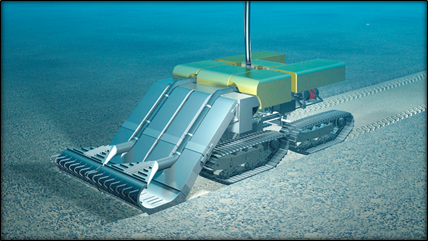
- Underwater Mining System (‘Varaha’): A heavy-duty seabed locomotion crawler that has successfully completed deep-water extraction trials at 5,270 meters.
Significance of the Deep Ocean Mission
- Catalyzing the Blue Economy: Aims to double ocean-based industrial contributions (blue trade and manufacturing) from 5% to over 10% of India’s GDP.
- Unlocking Energy Reserves: Secures access to vast underwater gas hydrates, offering potential energy equivalent to 1 lakh nuclear reactors.
- Enhancing Maritime Security: Provides cutting-edge underwater engineering and communication capabilities that directly augment the operational domain of the Indian Navy.
- Climate Mitigation Leadership: Supports evidence-based policymaking by mapping marine carbon dynamics, aligning with the UN Decade of Ocean Science (2021-2030).
Major Environmental and Operational Challenges
- Destructive Sediment Plumes: Pumping slurry and extracted sediments back into the sea creates massive sediment plumes that smother benthic creatures and severely harm filter-feeding species like deep-water corals and sponges.
- Pollution and Contamination: Extraction machinery introduces unprecedented noise, vibration, and light pollution into entirely dark ecosystems, alongside the severe risk of toxic leaks and chemical fuel spills.
- Disruption of Marine Food Webs: Mining impacts extend far beyond the seabed, threatening pelagic fish populations, marine mammals, and the deep ocean’s essential function in regulating the global climate.
- Extreme Subsea Pressures: Operating at 6,000 meters involves crushing pressure levels exceeding 60 Megapascals (MPa), demanding highly specialized materials to prevent equipment failure.
- Operational Friction: Navigating soft, muddy seabeds poses a severe sinking risk for heavy machinery, while absolute darkness and the natural attenuation of electromagnetic waves heavily restrict remote navigation.
- The “Capability Equals Permission” Fallacy: The dangerous assumption that demonstrating technical capacity inherently justifies the exploitation of fragile benthic habitats before global governance codes are finalized.
Way Forward for Sustainable Ocean Governance
- Marine Biomimetics: Design submersibles and extraction equipment inspired by deep-sea organisms to naturally withstand extreme pressure, salinity, and corrosion.
- Sustainable Energy Innovations: Harness tidal, wave, and OTEC technologies to power long-duration underwater missions sustainably.
- Advanced Sensor Integration: Combine sonar, LiDAR, and AI-driven imaging technologies for comprehensive, non-invasive deep-sea mapping, overcoming severe visibility limitations.
- Strict “Necessity Testing”: Before sanctioning any commercial seabed mining, mandate empirical evidence demonstrating that virgin minerals are irreplaceable and alternatives cannot substitute them.
- Establish Protected Marine Zones: Utilize environmental baseline data to formally declare vulnerable seamounts and hydrothermal vents as permanent, undisturbed conservation zones.
- Integrate Mission LiFE Principles: Decouple scientific exploration from commercial exploitation by prioritizing circular economies and mindful utilization over continuous primary extraction.
Conclusion
India’s mastery of deep-sea technology presents a unique civilizational test. By balancing strategic resource acquisition with stringent ecological precaution and circular consumption, the Deep Ocean Mission empowers India to set a global benchmark for responsible and truly sustainable ocean governance.
| Important Current to Concept (CTC) from this Article for UPSC 1. Ministry of Earth Sciences (MoES) 2. Polymetallic Nodules |