
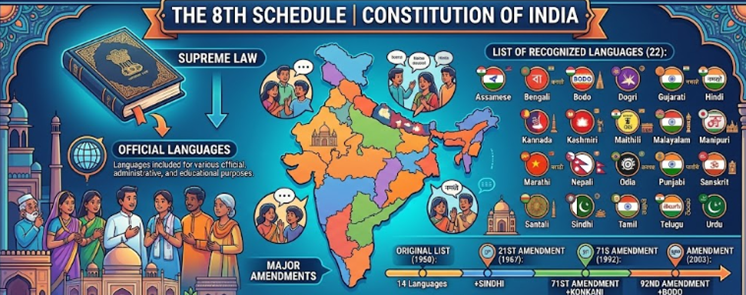
About the Eighth Schedule
- The Eighth Schedule of the Constitution of India lists the languages recognised for specific constitutional purposes.
- It currently contains 22 languages.
- The Eighth Schedule is linked with Articles 344(1) and 351 of the Constitution.
- Article 344 provides for a Commission and Committee of Parliament concerning the progressive use of Hindi for official purposes, while Article 351 directs the Union to promote the spread and development of Hindi by drawing upon Hindi and the other languages specified in the Eighth Schedule.
Languages in the Eighth Schedule
The 22 scheduled languages are:
- Assamese
- Bengali
- Bodo
- Dogri
- Gujarati
- Hindi
- Kannada
- Kashmiri
- Konkani
- Maithili
- Malayalam
- Manipuri
- Marathi
- Nepali
- Odia
- Punjabi
- Sanskrit
- Santhali
- Sindhi
- Tamil
- Telugu
- Urdu
Origin & Evolution
- The Eighth Schedule originally contained 14 languages when the Constitution came into force.
- Sindhi was added through the 21st Constitutional Amendment Act, 1967.
- Konkani, Manipuri and Nepali were added through the 71st Constitutional Amendment Act, 1992.
- Bodo, Dogri, Maithili and Santhali were added through the 92nd Constitutional Amendment Act, 2003, which came into effect in 2004.
- The 96th Constitutional Amendment Act, 2011 changed the name “Oriya” to “Odia” in the Eighth Schedule.
Constitutional Significance
- The Eighth Schedule provides a constitutional framework for recognising India’s linguistic diversity.
- The scheduled languages are specifically referred to in Article 344 and Article 351.
- Inclusion in the Eighth Schedule does not make a language the official language of the Union.
- Hindi in Devanagari script is the official language of the Union under Article 343, while English continues to be used for official purposes as provided by law.
Conclusion
The Eighth Schedule reflects India’s linguistic diversity and provides constitutional recognition to 22 languages. Its provisions are particularly important for understanding the relationship between language, constitutional provisions and India’s multilingual character.
| This concept has been elaborately discussed in the – Tulu Gets Additional Official Language Status in Karnataka |