
Context
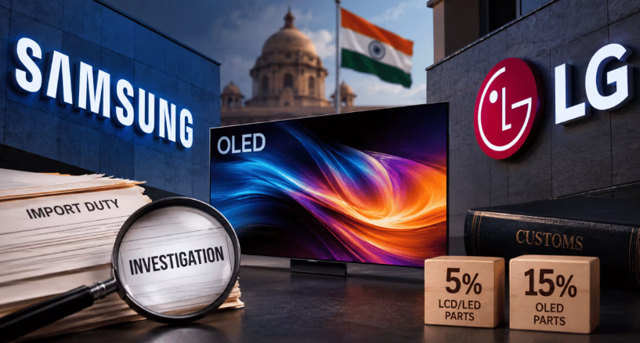
- India is investigating LG Electronics and Samsung over allegations of paying a lower import duty on OLED display components used in high-end televisions.
What is the Dispute and Why the Tariff Dispute Matters?
- India’s customs schedule offers a concessional 5% duty on open cells for LCD/LED TVs (to promote domestic TV assembly under “Make in India”).
- DRI’s contention: OLED is technologically distinct from LCD/LED (self-emissive vs backlit), so it doesn’t qualify for the same concessional slab — hence the demand for 15% duty.
- Companies argue: OLED is just an evolved/advanced form of LED, so the same concessional rate should extend to it.
- This is essentially a product classification dispute under the Customs Tariff Act — a recurring theme in India’s trade-tax landscape (similar disputes have hit Samsung and Volkswagen previously).
Basic Concept: LED vs LCD vs OLED (Display Technologies)
| Parameter | LCD (Liquid Crystal Display) | LED (Light Emitting Diode) | OLED (Organic Light Emitting Diode) |
| Light Source | External backlight using Cold Cathode Fluorescent Lamps (CCFL). | External backlight using inorganic LED diodes. | Self-emissive; individual organic pixels generate their own light. |
| Technology Class | Transmissive (requires backlight behind liquid crystals). | Transmissive (a subtype of LCD display using LED backlighting). | Emissive (no backlight layer required). |
| Material Base | Inorganic liquid crystals and glass layers. | Inorganic semiconductors (Gallium Nitride, Silicon, etc.). | Organic (carbon-based) small molecules or polymers. |
| Black Levels & Contrast | Poor black levels due to constant light leakage from CCFL backlight. | Moderate black levels; dynamic dimming helps but backlight leakage persists. | True/Absolute Black; individual pixels switch completely off (infinite contrast ratio). |
| Form Factor & Flexibility | Bulky, rigid, and energy-intensive. | Thinner than LCD, but limited flexibility due to backlight requirements. | Ultra-thin, flexible, rollable, and foldable display panels. |
| Viewing Angles | Narrow viewing angles; color shift at off-center positions. | Moderate to good viewing angles. | Exceptionally wide viewing angles without loss of contrast. |
Q. With reference to display technologies used in consumer electronics, consider the following statements:
1. Unlike conventional LCD and LED displays, an OLED display is self-emissive and does not require a separate backlight unit.
2. OLED displays utilize carbon-based organic compounds that emit light directly when subjected to an electric current.
3. Commercial "LED TVs" are fundamentally a subtype of Liquid Crystal Displays (LCDs) that utilize light-emitting diodes as their backlighting source.
Which of the statements given above are correct?
(a) 1 and 2 only
(b) 2 and 3 only
(c) 1 and 3 only
(d) 1, 2 and 3
Correct Answer: (d) 1, 2 and 3
Detailed Explanation & Statement Breakdown:
• Statement 1 is correct: Liquid Crystal Displays (LCDs) and conventional LED TVs rely on a transmissive system that requires a separate backlight behind liquid crystal panels. In contrast, Organic Light Emitting Diode (OLED) displays are emissive—each individual pixel generates its own light, eliminating the need for a backlight layer.
• Statement 2 is correct: OLED technology uses thin layers of organic (carbon-based) semiconductor materials placed between two conductors. When electric current passes through these organic layers, electroluminescence occurs, generating direct light.
• Statement 3 is correct: A standard consumer "LED TV" is actually an LCD screen. The term "LED TV" simply signifies that the display uses an array of Light Emitting Diodes (LEDs) for backlighting instead of older Cold Cathode Fluorescent Lamps (CCFLs).