
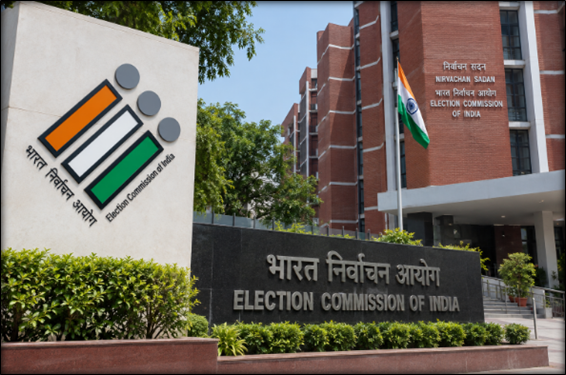
Introduction
The Election Commission of India (ECI) is a permanent constitutional body under Article 324, entrusted with ensuring the conduct of elections in India through an independent and impartial electoral machinery.
Constitutional Status
- Article 324 vests the ECI with the superintendence, direction and control of electoral rolls and elections to Parliament, State Legislatures, and the offices of the President and Vice-President.
- The ECI came into existence on 25 January 1950 and is therefore one of India’s key constitutional institutions for democratic governance.
Composition
- Under Article 324, the Commission comprises the Chief Election Commissioner (CEC) and such number of other Election Commissioners as the President may determine.
- When other Election Commissioners are appointed, the CEC acts as the Chairman of the Commission.
- The ECI has functioned as a three-member Commission since 1993, with decisions taken through collective decision-making.
Appointment and Tenure
- Under the 2023 Act, the CEC and other Election Commissioners are formally appointed by the President.
- The Selection Committee consists of the Prime Minister, Leader of Opposition in Lok Sabha and a Union Cabinet Minister nominated by the Prime Minister.
- They hold office for six years or until attaining 65 years of age, whichever is earlier, and are not eligible for reappointment.
Major Functions
- The ECI conducts elections to the Lok Sabha, Rajya Sabha, State Legislative Assemblies, State Legislative Councils where applicable, and the offices of President and Vice-President.
- It supervises the preparation and revision of electoral rolls, thereby protecting citizens’ electoral participation.
- It registers and recognises political parties and allots election symbols under the applicable legal framework.
- It administers the Model Code of Conduct during elections to maintain a level playing field among political parties and candidates.
- It also undertakes voter-awareness and electoral-participation initiatives to strengthen democratic participation.
Decision-Making within ECI
- All Election Commissioners have an equal say in decision-making, despite the CEC being the Chairman.
- The 2023 Act provides that ECI business should, as far as possible, be conducted unanimously; where Commissioners differ, the majority view prevails.
- Therefore, internal differences or dissent are compatible with the functioning of a multi-member Commission, provided the final decision follows the prescribed legal procedure.
Importance of ECI
- Democratic legitimacy: The ECI provides the institutional framework through which citizens periodically choose their representatives.
- Free and fair elections: Its constitutional mandate is central to maintaining electoral fairness and a level playing field.
- Protection of electoral rights: Accurate electoral rolls and accessible electoral procedures help prevent wrongful exclusion of eligible citizens.
- Institutional checks and balances: A multi-member Commission enables collective deliberation and reduces excessive concentration of decision-making authority.
- Constitutional governance: The ECI acts as an important institutional safeguard against arbitrary interference in the electoral process.
Conclusion
A credible ECI requires a balance of independence, transparency, collective deliberation and accountability. Strengthening these attributes can ensure that electoral administration remains impartial, rights-oriented and capable of sustaining public confidence in Indian democracy.
| This Concept Has Been Covered Under The Article: Election Commission of India: Internal Dissent, Decision-Making and Electoral Integrity |