
Context
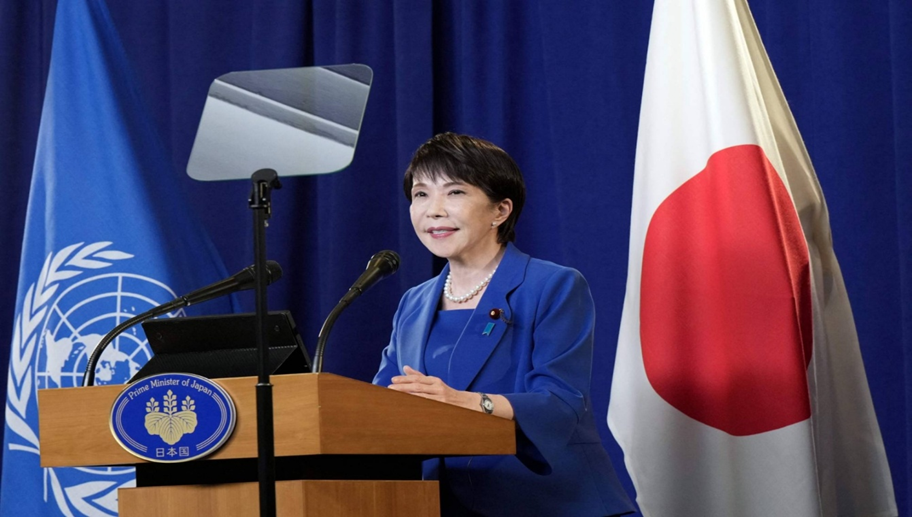
- Recently, Japan’s Prime Minister Sanae Takaichi, in her address to the UN General Assembly (UNGA), called for the removal of the obsolete “enemy state” clauses from the UN Charter and advocated reforms to make the UN Security Council (UNSC) more representative of present-day global realities.
What is an ‘Enemy State’?
- The UN Charter, drafted towards the end of World War II, came into force on 24 October 1945.
- It contains references to “enemy states” — a term applying to any state that was an enemy of an Allied signatory during World War II (primarily the Axis Powers: Germany, Italy, Japan).
- The clause was intended by the Allied Powers (Britain, USSR, USA) as a mechanism to counter the re-emergence of militarism or fascism in the defeated Axis states, without needing UN Security Council (UNSC) authorisation.
Where It Appears in the UN Charter
| Article | Provision |
| Article 53 | Allows enforcement action against an “enemy state” under regional arrangements without prior UNSC authorisation — an exception to the general rule. |
| Article 107 | Permits Allied Powers to take enforcement action against former Axis “enemy states” as a result of WWII, without needing UN approval. |
| Article 77(1)(b) | Relates to applying the “Trusteeship System” to territories detached from “enemy states” after WWII. |
About UN Trusteeship System
- Established under the Charter (Articles 73, 75) for “trust territories” — regions whose people had not yet attained full self-government.
- There were 11 such territories, located in Africa and the Pacific Islands.
Issues Surrounding the Clauses
- Obsolete Provisions: The UNGA recognised the “enemy state” clauses as obsolete in 1995, and the 2005 World Summit called for their removal. However, they continue to remain part of the UN Charter.
- Charter Amendment Hurdles: Under Article 108, amendments require a two-thirds majority of the UNGA and ratification by two-thirds of UN member states, including all five permanent members of the UNSC.
- Link with UNSC Reform: Removing these clauses would require reopening the UN Charter, potentially triggering broader debates on UNSC restructuring, permanent membership and representation, including the aspirations of countries such as Japan and Germany.
Q. With reference to the United Nations (UN) Charter, consider the following statements:
1. Articles 53 and 107 permit enforcement actions against an "enemy state" without prior authorization from the UN Security Council.
2. The term "enemy state" applies to any state that was an enemy of any signatory of the UN Charter during the Second World War.
3. An amendment to remove these clauses from the UN Charter requires approval by a two-thirds majority in the UN General Assembly and ratification by all five permanent members of the UN Security Council.
Which of the statements given above is/are correct?
(a) 1 and 2 only
(b) 2 and 3 only
(c) 1 and 3 only
(d) 1, 2 and 3
Correct Answer: (d) 1, 2 and 3
Explanation:
• Statement 1 is correct: Under Paragraph 1 of Article 53 and Article 107 of the UN Charter, enforcement measures against an "enemy state" serve as an exception to the general rule requiring prior UN Security Council authorization for the use of military force.
• Statement 2 is correct: Paragraph 2 of Article 53 explicitly defines an "enemy state" as any state that was an enemy of any signatory of the UN Charter during the Second World War (such as Germany, Japan, or Italy).
• Statement 3 is correct: Under Article 108 of the UN Charter, any amendment to the Charter must be adopted by a two-thirds vote of the members of the UN General Assembly and ratified by two-thirds of the UN member states, including all five permanent members (P5) of the Security Council.