
Context
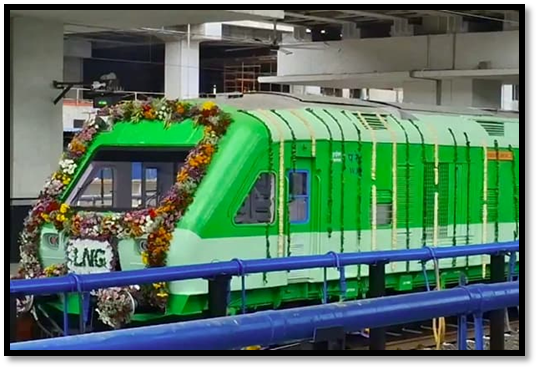
- India has introduced its first LNG-powered train from Sabarmati Railway Station in Ahmedabad, Gujarat, marking an important step toward using alternative fuels in railway transport.
About the Train
- Dual-Fuel Technology: Unlike pure LNG propulsion, the newly introduced train utilizes a diesel-LNG dual-fuel system.
- Fuel Substitution & Efficiency: LNG can replace roughly 40% of conventional diesel consumption.
- Driving Power Cars (DPCs): Two 1,400 HP DPCs at the Sabarmati Integrated Coaching Depot were converted to support this dual-fuel capability.
- Emission Reduction: The technology substantially lowers emissions of carbon dioxide, nitrogen oxides, and particulate matter (PM).
About LNG
- Full Form: Liquefied Natural Gas
- State: Liquid
- Process: Cooled to about −162°C
- Storage: Cryogenic tanks
- Volume: More energy-dense; occupies less space
- Major Use: Heavy transport, shipping, railways
- Key Advantage: Suitable for long-distance, high-energy applications
| Important CTC from this article for UPSC: Dedicated Freight Corridors |
Q. Consider the following statements regarding Liquefied Natural Gas (LNG):
1. LNG is produced by cooling natural gas to approximately −162°C.
2. LNG is primarily composed of methane.
3. Unlike CNG, LNG is stored in a gaseous state under high pressure.
4. LNG is a zero-emission fuel because it does not produce carbon dioxide during combustion.
Which of the statements given above is/are correct?
(a) 1 and 2 only
(b) 1, 2 and 3 only
(c) 2 and 4 only
(d) 1, 2, 3 and 4
Answer: (a) 1 and 2 only
• Statement 1 is Correct: Natural gas is cooled to approximately −162°C to convert it into liquid form.
• Statement 2 is Correct: LNG consists predominantly of methane (CH₄).
• Statement 3 is Incorrect: CNG is stored as compressed gas under high pressure, whereas LNG is stored in liquid form at cryogenic temperatures.
• Statement 4 is Incorrect: LNG is still a fossil fuel and its combustion releases CO₂. It is therefore not a zero-emission fuel.