
Context
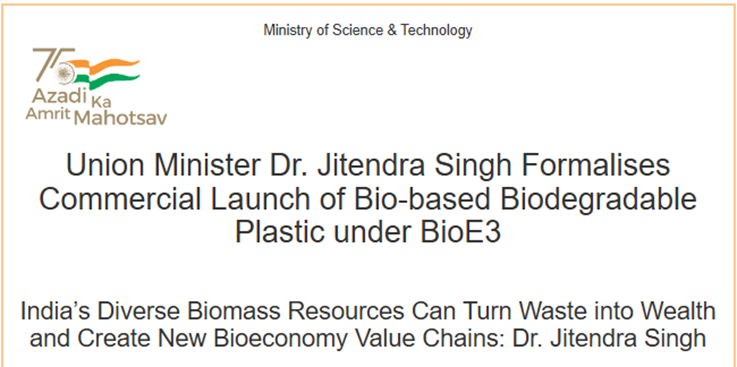
- Recently, the Union Minister launched the commercial use of Polylactic Acid (PLA)-based bio-based biodegradable plastic, linking biotechnology with sustainable manufacturing, commercialisation and employment generation.
About Polylactic Acid (PLA)
- PLA is a bio-based polymer used for developing biodegradable plastic and sustainable materials.
- Unlike petroleum-derived plastics like PET or ABS, PLA is made from renewable organic resources such as corn starch, sugarcane, or cassava roots.
Core Characteristics & Properties of PLA
- Biodegradability: Industrially compostable. Under high humidity and temperatures around 60°C (140°F) in commercial facilities, PLA breaks down into water, carbon dioxide, and biomass within 3 to 6 months.
- Thermal Properties: Low melting point around 150°C–160°C (302°F–320°F) and a glass transition temperature around 60°C. It softens easily when exposed to hot liquids or high temperatures.
- Mechanical Strength: High tensile strength and stiffness, but brittle with low impact resistance compared to plastics like polypropylene or ABS.
Key Applications
- 3D Printing: PLA is the most popular filament material for Fused Deposition Modeling (FDM) 3D printing due to its minimal warping, low printing temperatures, and ease of use.
- Packaging: Single-use items such as cold drink cups, takeaway food containers, clear clamshell packaging, and plastic films.
- Medical Devices: Biocompatible and bioabsorbable implants, surgical sutures, bone screws, and tissue engineering scaffolds that naturally break down inside the body over time.
- Textiles: Fibers used in tea bags, disposable wipes, and synthetic fabrics.
Significance
- Converts agricultural biomass into high-value products, supporting the “Waste-to-Wealth” approach.
- Developing new avenues for sugarcane and agricultural waste diversifies sugar-mill income while fueling India’s ambition to build a $300 billion bioeconomy.
- By scaling sustainable plastic alternatives, this initiative enforces India’s Plastic Waste Management Rules and fuels its path toward net-zero emissions.
Conclusion
The BioE3-backed PLA initiative represents the movement of Indian biotechnology from laboratory research towards commercial-scale sustainable manufacturing. By connecting agricultural biomass, biotechnology, indigenous manufacturing and green materials, the initiative seeks to create new bio-based value chains while supporting economic growth, environmental sustainability and employment.
| Important CTC From This Article – BioE3 |