
Context
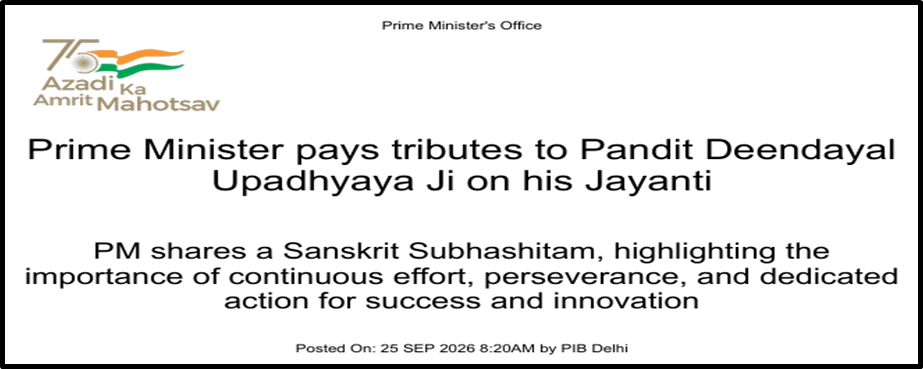
- The Prime Minister of India, paid tributes to Pandit Deendayal Upadhyaya on his Jayanti (25 September), highlighting his vision of ‘Antyodaya’ and the upliftment of the marginalised as the foundation of nation-building.
About Pandit Deendayal Upadhyaya
- Pandit Deendayal Upadhyaya was born on 25 September 1916 and died on 11 February 1968. He was a thinker, writer, journalist, economist and political organiser.
- He was a key leader and ideologue of the Bharatiya Jana Sangh.
- He is particularly associated with the concepts of Antyodaya and Integral Humanism (Ekatma Manav Darshan).
- His philosophy emphasised the holistic development of the individual, society and nation, rather than viewing human beings only through an economic lens.
Key Concept of Antyodaya
- Antyodaya: It means the upliftment of the last person, especially the poorest and most marginalised.
- It emphasises ensuring that development and welfare reach the weakest sections of society.
- Antyodaya Diwas is observed on the birth anniversary of Deendayal Upadhyaya.
Key Concept of Integral Humanism
- A socio-economic and political philosophy advocating a holistic view of human life — integrating body, mind, intellect, and soul.
- Rejects both unrestrained capitalism and communism, proposing an indigenous “third way” rooted in Indian civilizational values.
- Emphasises decentralisation, self-reliance, and duty (dharma) over rights-based individualism alone.
Conclusion
Pandit Deendayal Upadhyaya’s ideas of Antyodaya and Integral Humanism placed human welfare, social responsibility and the upliftment of marginalised sections at the centre of his vision of nation-building. His Jayanti provides an opportunity to revisit these concepts and their relevance to inclusive development, social justice and governance.
| Important CTC from this article for UPSC Prelims — Antyodaya Diwas |