
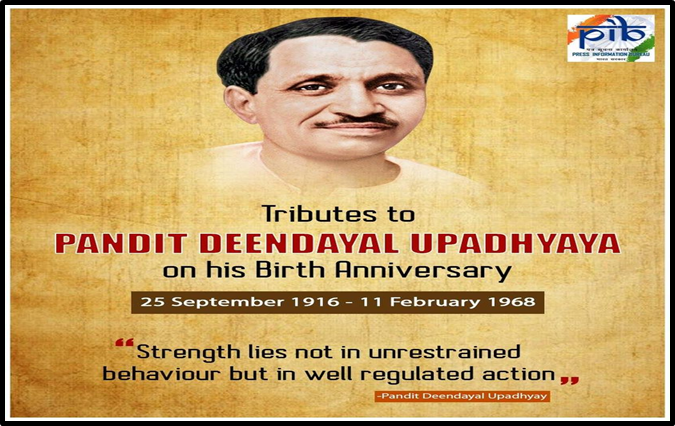
About Antyodaya Diwas
- Antyodaya Diwas is observed annually on 25 September to mark the birth anniversary of Pandit Deendayal Upadhyaya (25 September 1916), a thinker who propounded the doctrine of Integral Humanism.
- The Government of India instituted the observance in 2014, focusing on the welfare and social-justice needs of the country’s most disadvantaged sections.
Meaning and Guiding Philosophy
- Etymology: Antyodaya combines the Sanskrit terms Antya (“the last” or “the poorest”) and Udaya (“rise”), signifying the upliftment of the last person in the development process.
- Governing Principle: Upadhyaya held that governance should be assessed by whether development benefits reach the weakest and last citizen, rather than by aggregate wealth alone.
Welfare Schemes Anchored to Antyodaya
- Antyodaya Anna Yojana (AAY): Launched in 2000 to provide highly subsidised rice and wheat to identified Below Poverty Line (BPL) households.
- Deendayal Antyodaya Yojana (DAY): Operates through DAY-NRLM and DAY-NULM, focusing on Self-Help Groups (SHGs), skill development and micro-enterprises.
- Deen Dayal Upadhyaya Grameen Kaushalya Yojana (DDU-GKY): Launched on 25 September 2014as a placement-linked skill-training programme for rural youth aged 15–35 years.
- State-Level Initiatives: States have also undertaken Antyodaya-linked programmes, such as Tripura’s Ekdunia Antyodaya Digital Mission, focusing on technology access, healthcare and digital literacy in rural areas.
Conclusion
Antyodaya Diwas functions simultaneously as a tribute to Pandit Deendayal Upadhyaya and as an annual policy checkpoint for India’s poverty-alleviation architecture.
By anchoring flagship programmes such as AAY, DAY-NRLM/NULM, and DDU-GKY to a single observance, the day reinforces Antyodaya as a running metric for inclusive development.
| This concept has been elaborately discussed in the following article – Tribute to Pandit Deendayal Upadhyaya |