
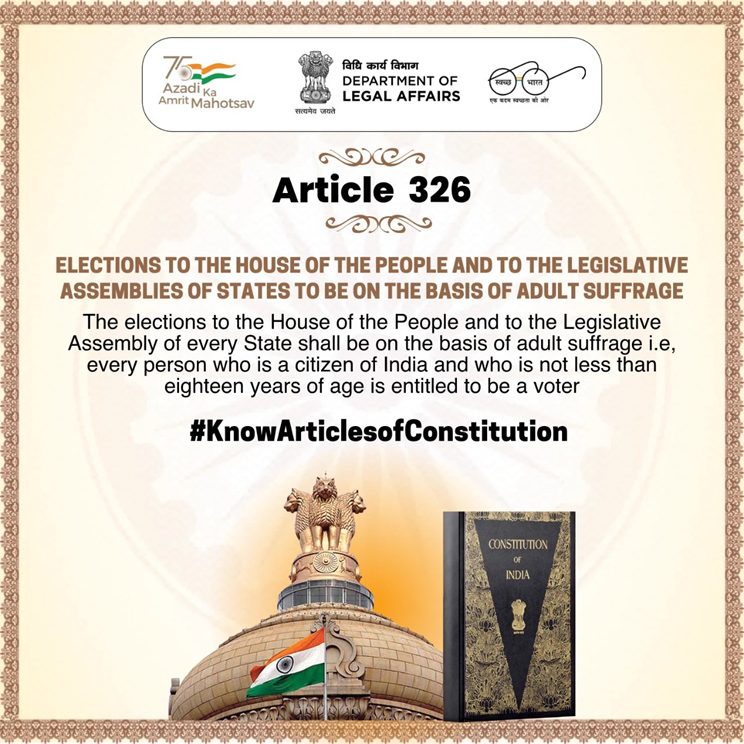
About Article 326 of Indian Constitution
Article 326 of the Indian Constitution establishes universal adult suffrage, guaranteeing every eligible citizen aged 18 or above the right to vote in Lok Sabha and State Legislative Assembly elections. This provision forms the foundation of India’s representative democracy by ensuring fair, inclusive, and direct electoral participation.
What are its Core Provisions?
- Universal Adult Suffrage: Every Indian citizen aged 18 or above possesses the right to vote, ensuring equal participation in the democratic process regardless of caste, religion, gender, race, or economic status.
- Electoral Applicability: The article specifically governs direct elections to the House of the People (Lok Sabha) and the State Legislative Assemblies.
- Constitutional Guarantee: It protects the right to vote as a constitutional mandate, safeguarding citizens from arbitrary disenfranchisement and ensuring their right to be included in electoral rolls.
- Regulation by Law: It empowers Parliament and State Legislatures to enact laws regulating electoral eligibility, procedures, and disqualifications (e.g., the Representation of the People Acts, 1950 and 1951).
- Direct Elections: It ensures that representatives in the Lok Sabha and State Assemblies are elected directly by the voters, establishing direct democratic accountability.
Article 326 of Indian Constitution Amendments
- The Original Mandate: Initially, the Constitution restricted the universal voting franchise exclusively to citizens aged 21 and above.
- 61st Constitutional Amendment Act (1988): Officially lowered the constitutionally mandated voting age from 21 to 18 years, fundamentally altering the demographic of the Indian electorate.
- Rationale for Amendment: Executed to encourage youth participation in the democratic process, granting young citizens a direct and decisive voice in national governance.
- Democratic Impact: Integrated millions of new young voters into the electoral system, significantly enhancing political awareness among the youth and reinforcing the inclusivity of universal adult suffrage.
- Statutory Alignment: Necessitated immediate corresponding changes to the Representation of the People Act, 1950, to systematically register the 18-to-21 demographic, which became effective from March 1989.
Exceptions and Legal Disqualifications
- General Disqualifications: Non-citizens and individuals legally declared to be of unsound mind by a competent court are strictly barred from voting.
- Criminal and Electoral Offenses: Individuals convicted of severe crimes (like terrorism or corruption) or electoral malpractices under the Representation of the People Act, 1951, forfeit their voting rights, though they may regain them post-sentence or through legal appeals.
- Prisoners and Confinement: Convicted prisoners legally lose their right to vote, whereas undertrial prisoners (those not yet formally convicted) retain their voting rights.
- Service Personnel: Government employees or diplomats posted abroad may face temporary voting restrictions due to official rules, though alternative mechanisms are often provided to facilitate their participation.
Conclusion
Article 326 stands as the ultimate democratic equalizer in India, ensuring absolute political parity through universal adult suffrage. By empowering every eligible citizen with the ballot, it continuously transforms the constitutional promise of a representative republic into an actionable reality.
| This Concept Has Been Mentioned In The Article: From Statutory to Fundamental: Securing the Ballot Against Systemic Vulnerabilities |