
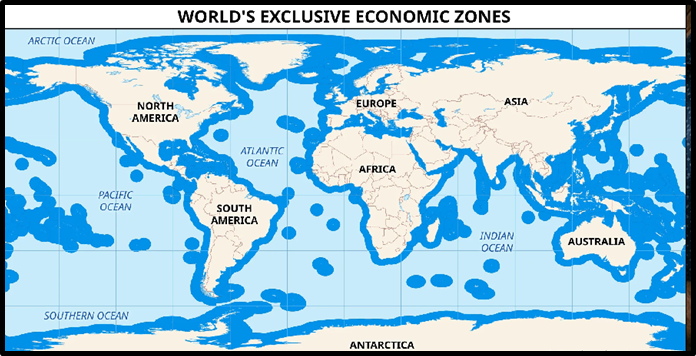
About the Exclusive Economic Zone
- The Exclusive Economic Zone (EEZ), established under Part V (Articles 55–75) of UNCLOS, 1982, extends up to 200 nautical miles from the coastal baseline and gives coastal states special rights over marine resources while preserving international freedoms. UNCLOS was concluded at Montego Bay in 1982 and entered into force on 16 November 1994.
Rights and Jurisdiction of the Coastal State
- Resources & Energy: Sovereign rights to explore, exploit, conserve and manage living resources (fisheries) and non-living resources (oil, gas, seabed minerals) in the water column, seabed and subsoil, and to generate energy from water, currents and winds.
- Jurisdiction: Exclusive authority over — artificial islands, installations and structures; marine scientific research; and protection and preservation of the marine environment.
Rights and Duties of Other States
- Freedoms Retained: All states, coastal or landlocked, enjoy freedom of navigation, freedom of overflight and the freedom to lay submarine cables and pipelines, with mutual due regard for each other’s rights and duties.
- Landlocked & Geographically Disadvantaged States: May participate in exploiting the surplus living resources of neighbouring coastal states’ EEZs (Articles 69–70).
India and the EEZ
- Domestic Law & Treaty: The Territorial Waters, Continental Shelf, Exclusive Economic Zone and Other Maritime Zones Act, 1976 (Section 7) declares India’s EEZ up to 200 NM; India ratified UNCLOS on 29 June 1995.
Key Facts on EEZ
| Parameter | Detail |
| Legal Basis | Part V (Articles 55–75), UNCLOS 1982 |
| Breadth | Up to 200 NM from baseline (Territorial Sea: up to 12 NM) |
| Legal Status | Functional sovereign rights over resources plus specific jurisdiction (Territorial Sea: full sovereignty) |
| Foreign Vessels | Freedoms of navigation and overflight (Territorial Sea: innocent passage) |
| Customary Status | Recognised as part of customary international law |
| Islands | Under Article 121, islands generate their own EEZ; rocks that cannot sustain human habitation or economic life do not |
Conclusion
The EEZ gives a coastal state sovereign rights over resources up to 200 NM from its baseline under UNCLOS Part V, while preserving navigation, overflight and cable-laying freedoms for all states. It is wider than the 12 NM territorial sea but confers only functional rights.
| This concept has been elaborately discussed in the following article – Bharat Maritime Insurance Pool (BMIP) |