
Context
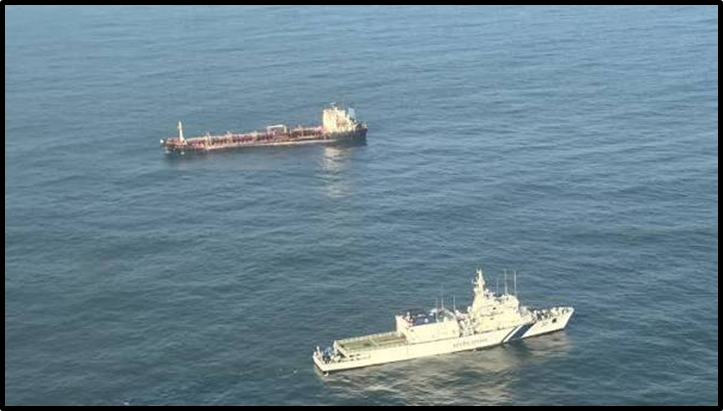
- Recently, the Indian Coast Guard (ICG) rescued the distressed Belize-flagged tanker MT Seagull 9, about 37 nautical miles east-south-east of Paradip (Odisha), and prevented a major oil spill.
About the Incident
- MT Seagull 9, a Belize-flagged vessel carrying palm oil, developed a dangerous tilt after engine failure and rapid ballast-tank flooding off the Odisha coast.
- The incident posed a risk of capsizing and marine pollution, prompting a rescue and stabilisation operation by the Indian Coast Guard.
Coast Guard Response
- ICGS Vishwast: Pressed into service; a specialist damage control team boarded the unstable vessel.
- Damage control: Submersible de-flooding pumps used; leakage arrested, two damaged seawater pipelines blanked and a third fractured line contained.
- Stabilisation: Concurrent cargo transfer and de-flooding eliminated the threat of capsizing.
- Pollution response: Pollution Control Vessel (PCV) and an additional Offshore Patrol Vessel (OPV) diverted to the location.
- Aerial surveillance: Dornier aircraft monitored in real time; a minor palm oil sheen seen on 27 September was confirmed fully dissipated on 28 September.
- Multi-agency effort: Paradip Port Authority tug Dolphin towed the stabilised vessel to the anchorage area off Paradip.
About the Indian Coast Guard
- Ministry: Functions under the Ministry of Defence; established under the Coast Guard Act, 1978.
- Motto: “Vayam Rakshamah” (We Protect).
- Oil spills: ICG is the Central Coordinating Authority for marine oil spill response under the National Oil Spill Disaster Contingency Plan (NOS-DCP).
| Important CTC from this article for UPSC Prelims – Indian Coast Guard (ICG) |
Q. Consider the following statements about the Indian Coast Guard (ICG):
I. It functions under the Ministry of Home Affairs.
II. It is a statutory body established under the Coast Guard Act, 1978.
III. It is the Central Coordinating Authority for marine oil spill response in Indian waters under the National Oil Spill Disaster Contingency Plan (NOS-DCP).
Which of the statements given above is/are correct?
(a). I and II only
(b). II and III only
(c). I and III only
(d). I, II and III
Answer: (b)
Explanation
Statement I is Incorrect: The ICG functions under the Ministry of Defence, not the Ministry of Home Affairs.
Statement II is Correct: The ICG began as an interim force in 1977 and became a statutory body under the Coast Guard Act, 1978.
Statement III is Correct: The ICG is the Central Coordinating Authority for marine oil spill response under the NOS-DCP, which is why it led the MT Seagull 9 operation.