
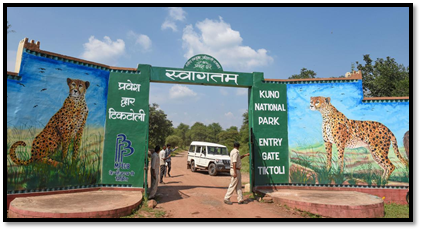
About Kuno National Park
- Kuno National Park is located in Sheopur district of Madhya Pradesh, in the Vindhyan landscape of central India.
- The Kuno River, a tributary of the Chambal River, flows through the protected area.
- Its landscape consists mainly of dry deciduous forests, open woodland, grasslands and riverine habitats.
- The area has a suitable combination of prey availability, habitat and relatively low human pressure, making it suitable for cheetah reintroduction.
- Physiography: Situated in the Vindhyan Hill range, falling within the transitional zone between the Malwa Plateau and the Bundelkhand uplands.
- Protected Area Timeline:
- Initially established as a Wildlife Sanctuary in 1981.
- Upgraded to a National Park in 2018 (specifically to meet criteria for relocating big cats).
Ecology, Flora & Fauna
- Biome/Vegetation: Northern tropical dry deciduous forests, mixed forests, and extensive open grasslands/savannah-type meadows ideal for cursorial predators.
- Dominant Tree Species: Kardhai, Salai, Khair, Teak, Saj, Tendu, and Bamboo.
- Fauna: Leopards, sloth bears, Indian wolves, jackals, chikara, nilgai, chital, and a rich avifauna and reptile profile (mugger crocodiles in the river stretches).
Conclusion:
- Kuno National Park represents the core of India’s effort to establish a viable and self-sustaining cheetah population, while its dry deciduous–grassland ecosystem supports a wider range of wildlife.
| This concept has been elaborately discussed in the following article – Veerangana Durgavati Tiger Reserve Becomes India’s Third Cheetah Habitat |