
Context
The Commission for Air Quality Management (CAQM) assessed Delhi and neighbouring States’ progress under their 2026 air pollution control action plans. While Delhi achieved targets in air quality monitoring, industrial inspections and EV charging infrastructure, it lagged in legacy waste clearance, public transport expansion, parking infrastructure and green crematorium development, highlighting persistent gaps in urban waste management and pollution control.
About the Commission for Air Quality Management (CAQM)
- Establishment: CAQM was constituted under the Commission for Air Quality Management in National Capital Region and Adjoining Areas Act, 2021.
- Nature: It is a statutory body established to improve coordination and address air pollution in the National Capital Region (NCR) and adjoining areas.
- Jurisdiction: It covers the National Capital Territory of Delhi and adjoining areas of Haryana, Punjab, Rajasthan and Uttar Pradesh.
- Nodal Ministry: Ministry of Environment, Forest and Climate Change.
- Headquarters: New Delhi.
Key Findings of the CAQM Report Card
The report assessed Delhi’s performance against its 2026 action plan targets, using data available up to October 31, 2026.
A. Areas where Delhi achieved its targets
- Air Quality Monitoring: Delhi achieved 100% of its target of installing 19 Continuous Ambient Air Quality Monitoring Stations (CAAQMS).
- Industrial Inspections: It completed 1,609 industrial inspections against a target of 979, exceeding the prescribed target.
- Diesel Generator Inspections: Delhi exceeded its target for inspections of diesel generator sets to monitor pollution emissions.
- EV Charging Infrastructure: It achieved its target for augmentation of electric vehicle charging stations.
- Construction and Demolition Waste: Delhi performed well in addressing construction and demolition waste management.
B. Areas where Delhi lagged behind
1. Legacy Waste Clearance
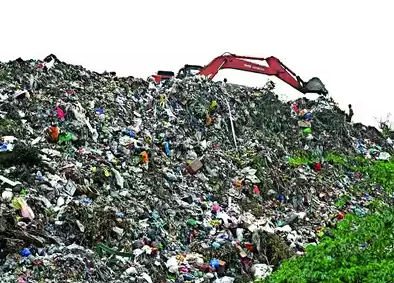
- Meaning: Legacy waste refers to accumulated, untreated municipal solid waste deposited at dumpsites or landfills over several years.
- Delhi achieved only partial clearance of legacy waste at its three major landfill sites.
- Ghazipur landfill recorded the lowest progress, clearing 16.53 lakh tonnes against a target of 39.12 lakh tonnes.
- The three landfill sites together still contain approximately 52.7 lakh metric tonnes of legacy waste.
2. Public Transport Infrastructure
- Delhi added 1,703 city buses against a target of 2,395, achieving approximately 71% of its target.
- Inadequate expansion of public transport can sustain dependence on private vehicles and contribute to vehicular emissions.
3. Parking Infrastructure
– Delhi completed only 15 out of 266 targeted parking lots, indicating significant delays in developing planned parking infrastructure.
4. Other Areas of Underperformance
- Delhi lagged in establishing green crematoriums.
- It also fell short of its targets for augmentation of large and small Mechanical Road Sweeping Machines (MRSM), which are used to reduce road dust pollution.
Scientific Methods for Clearing Legacy Waste
- Biomining: It involves the segregation and recovery of useful materials from old landfill waste through mechanical and biological processes.
- Bioremediation: It uses microorganisms to break down or reduce harmful organic contaminants in waste and contaminated soil.
- Waste-to-Energy: Suitable non-recyclable and combustible waste can be processed to generate energy, subject to emission-control standards.
- Material Recovery: Recyclable materials such as metals, plastics and other useful components can be recovered and reused.
- Scientific Landfill Management: Residual waste that cannot be recovered or processed safely should be disposed of in scientifically designed sanitary landfills.
| Important CTC from this Article- Commission for Air Quality Management (CAQM) |
                                         MCQ

Q. With reference to the Commission for Air Quality Management (CAQM) and solid waste management in India, consider the following statements:
1. The Commission for Air Quality Management is a statutory body established under the Environment (Protection) Act, 1986.
2. CAQM has jurisdiction over the National Capital Region and adjoining areas of Punjab, Haryana, Rajasthan and Uttar Pradesh.
3. Biomining of legacy waste involves the recovery of useful materials from accumulated waste at dumpsites.
4. The Solid Waste Management Rules, 2026 mandate segregation of solid waste into four streams at source.

Which of the statements given above are correct?
(a) 1 and 2 only
(b) 2, 3 and 4 only
(c) 1, 3 and 4 only
(d) 1, 2, 3 and 4
Answer: (b)

Explanation:
• Statement 1 is incorrect: CAQM is a statutory body established under the Commission for Air Quality Management in National Capital Region and Adjoining Areas Act, 2021, not directly under the Environment (Protection) Act, 1986.
• Statement 2 is correct: Its jurisdiction extends to NCR and adjoining areas of Punjab, Haryana, Rajasthan and Uttar Pradesh.
• Statement 3 is correct: Biomining involves the scientific processing and segregation of legacy waste to recover useful materials.
• Statement 4 is correct: The Solid Waste Management Rules, 2026 prescribe four-stream segregation into wet, dry, sanitary and special care waste.

                                         PYQ (2019)

Q. As per the Solid Waste Management Rules, 2016 in India, which one of the following statements is correct?
(a) Waste generators have to segregate waste into five categories.
(b) The Rules are applicable to notified urban local bodies, notified towns and all industrial townships only.
(c) The Rules provide for exact and elaborate criteria for the identification of sites for landfills and waste processing facilities.
(d) It is mandatory on the part of the waste generator that the waste generated in one district cannot be moved to another district.