
Context
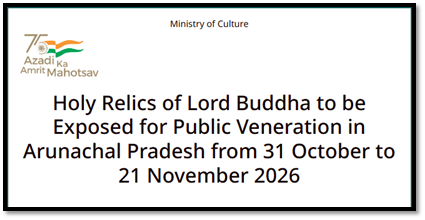
The Ministry of Culture, in collaboration with the Government of Arunachal Pradesh, the International Buddhist Confederation (IBC) and the National Museum, is organising an exposition of the Holy Relics of Lord Buddha in Arunachal Pradesh.
About the Exposition
- Organising Ministry: Ministry of Culture, Government of India.
- Collaborating Institutions: Government of Arunachal Pradesh, International Buddhist Confederation (IBC) and National Museum, New Delhi.
- Objective: To promote Buddhist heritage, provide devotees an opportunity for public veneration and strengthen India’s cultural and spiritual connections with Buddhist communities.
- The exposition coincides with Lhabab Düchen, a significant Tibetan Buddhist festival commemorating Lord Buddha’s descent from the heavenly realm.
About Lhabab Düchen Festival
- Meaning: Lhabab Düchen is a major Buddhist festival whose name means “The Descent from Heaven” in Tibetan.
- Religious Significance: It commemorates the descent of Lord Buddha from the Trāyastriṃśa (Tāvatiṃsa) Heaven to Earth.
- Associated Legend: According to Buddhist tradition, Lord Buddha ascended to this heavenly realm to teach the Dharma to his mother, Queen Māyā, who had been reborn there.
- Return to Earth: He is believed to have descended to Earth at Sankassa (modern-day Sankisa, Uttar Pradesh), accompanied by celestial beings.
- Observance: It is celebrated on the 22nd day of the ninth month of the Tibetan lunar calendar.
- Spiritual Significance: Buddhists believe that the positive and negative effects of actions (karma) are multiplied on this auspicious day. Devotees engage in prayers, meditation, offerings and acts of charity.
- Tradition: It is particularly observed by Tibetan Buddhist communities, including followers of the Vajrayana tradition.
About Sacred Piprahwa Relics
- Origin: The relics originate from Piprahwa in Siddharthnagar district, Uttar Pradesh, an archaeological site associated with ancient Kapilavastu and the Shakya tradition.
- Discovery (1898): British engineer and archaeologist William Claxton Peppé excavated a stupa at Piprahwa and discovered reliquaries containing bone fragments and precious objects.
- Further Excavations (1971–1977): The Archaeological Survey of India (ASI), under archaeologist K. M. Srivastava, conducted further excavations and discovered additional reliquary caskets.
- Sacred Relics: These excavations revealed 22 sacred bone fragments—20 are preserved at the National Museum, New Delhi, and two at the Indian Museum, Kolkata.
- Religious Significance: The relics are traditionally associated with Lord Buddha and are revered by Buddhist communities.
Arunachal Pradesh and Buddhist Traditions
- Arunachal Pradesh represents an important centre of Buddhist heritage in India’s northeastern Himalayan region.
- Tawang and West Kameng: Primarily associated with the Mahayana and Vajrayana traditions of Himalayan Buddhism.
- Tawang Monastery: Also known as Gaden Namgyal Lhatse, it is an important centre of Buddhist learning and monastic practice.
- Bomdila: Its monasteries preserve the religious and cultural traditions of Himalayan Buddhism.
- Namsai: Associated with the Theravada Buddhist tradition, particularly among the Tai Khamti community.
Conclusion
The exposition highlights India’s efforts to preserve and promote its rich Buddhist heritage while strengthening cultural and spiritual ties with Buddhist communities across the world. By bringing the sacred Piprahwa relics closer to devotees, it reinforces the values of peace, compassion and non-violence and enhances India’s role in Buddhist cultural diplomacy.