
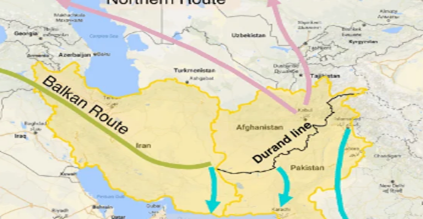
Golden Crescent (What is it?)
- The Golden Crescent is a major historical opium-producing region located in Southwest Asia.
- It comprises three countries: Afghanistan, Iran and Pakistan.
- The region has historically been associated with the cultivation of opium poppy and illicit production and trafficking of opiates, particularly heroin.
Geographical Extent
| Country | Significance |
| Afghanistan | Historically the principal source of illicit opium production in the region |
| Iran | Important geographical transit corridor |
| Pakistan | Transit routes connecting Afghanistan with international markets |
Important Features
1. Opium-Producing Region
- Opium is obtained from the latex of the opium poppy (Papaver somniferum).
- Morphine and heroin are opium-derived narcotic substances.
2. Major Trafficking Routes
- Historically connected to trafficking networks extending towards West Asia, Europe and South Asia.
- India’s western geographical proximity creates vulnerabilities to cross-border narcotics trafficking.
3. Recent Development
- The Taliban announced a ban on opium poppy cultivation in Afghanistan in April 2022.
- Subsequent UNODC assessments documented a substantial decline in Afghan opium cultivation, although illicit trafficking remains a concern.
Golden Crescent vs Golden Triangle
| Golden Crescent | Golden Triangle |
| Southwest Asia | Southeast Asia |
| Afghanistan, Iran, Pakistan | Myanmar, Laos, Thailand |
| Historically associated with opium and heroin | Associated with opium, heroin and synthetic drugs |
| Relevant to India’s western security concerns | Relevant to India’s northeastern security concerns |
Conclusion
The Golden Crescent remains strategically significant for understanding India’s western-border narcotics challenges and international drug trafficking routes.
| This Concept has been discussed in the following article: India’s Drug Trafficking Challenge: From Seizure-Based Enforcement to Dismantling Narcotics Networks |