
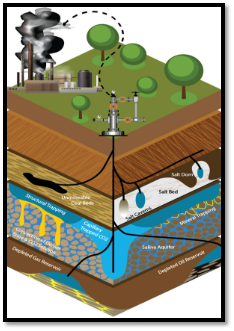
About Geological Storage
- Geological Storage refers to the process of injecting captured carbon dioxide (CO₂) into deep underground geological formations for long-term storage, preventing its release into the atmosphere.
- It is an important component of Carbon Capture and Storage (CCS) and Carbon Capture, Utilisation and Storage (CCUS) technologies.
- The process involves capturing CO₂ from industrial sources, compressing it, transporting it to a suitable site and injecting it into underground rock formations.
- Suitable geological formations have porous and permeable rocks that can hold CO₂ and an overlying impermeable rock layer that prevents its upward migration.
Types of Geological Formations Used for CO₂ Storage
- Deep Saline Formations:
- These are porous and permeable rock formations containing highly saline water, also known as brine.
- They are widely distributed across sedimentary basins and offer substantial potential for CO₂ storage.
- Depleted Oil and Gas Reservoirs:
- These are underground formations from which most of the oil or natural gas has already been extracted.
- Since these formations have naturally trapped hydrocarbons for geological periods, they may be suitable for storing injected CO₂.
- Unmineable Coal Seams:
- Coal deposits that cannot be economically or technically mined may be used for CO₂ storage.
- Injected CO₂ can be adsorbed onto the coal, potentially displacing methane trapped within it.
- Basalt Formations:
- Basalt is a volcanic rock that contains minerals capable of reacting with CO₂.
- Under suitable conditions, this reaction can convert CO₂ into stable carbonate minerals.
- Organic-Rich Shale Formations:
- Certain shale formations are being investigated for their potential to store CO₂, although their suitability depends on geological and technical conditions.
Process of Geological Storage
- Capture: CO₂ is separated from industrial emissions, such as those from power plants and cement and steel industries.
- Compression: The captured CO₂ is compressed to increase its density and facilitate transportation and underground injection.
- Transportation: CO₂ is transported to the selected storage site through pipelines, ships, trucks or rail.
- Injection: The CO₂ is injected through specially designed wells into suitable deep geological formations.
- Trapping and Storage: The injected CO₂ remains underground through physical, chemical and geological trapping mechanisms.
Mechanisms of CO₂ Trapping
- Structural and Stratigraphic Trapping:
- CO₂ accumulates beneath an impermeable rock layer, known as a caprock, which prevents it from migrating towards the surface.
- Geological structures and changes in rock layers help retain the injected CO₂.
- Residual Trapping:
- CO₂ becomes trapped within small pore spaces between rock grains, restricting its movement.
- Solubility Trapping:
- A portion of the injected CO₂ dissolves in the saline water present in the geological formation.
- Mineral Trapping:
- Dissolved CO₂ reacts with minerals in the surrounding rocks to form stable carbonate minerals.
- This process can permanently lock carbon into solid mineral forms over time.
Safety and Environmental Concerns
- CO₂ Leakage: Faulty wells or compromised geological seals may allow CO₂ to migrate out of the storage formation.
- Groundwater Contamination: Poorly selected sites or leakage pathways may affect underground water resources.
- Induced Seismicity: Changes in underground pressure during injection may trigger seismic activity in susceptible geological settings.
- Site Selection: Detailed geological assessment is necessary to identify suitable formations with adequate storage capacity and integrity.
- Monitoring: Continuous monitoring, verification and risk management are essential to ensure long-term storage security.
Conclusion
Geological Storage is a key component of carbon capture and storage technologies that can help reduce industrial CO₂ emissions. Its effectiveness depends on suitable geological formations, secure caprock, careful site selection and long-term monitoring. For UPSC Prelims, the most important areas are types of storage formations, CO₂ trapping mechanisms, the role of caprock and the relationship between Geological Storage and CCUS.
| This concept has been mentioned in the following article: Carbon Capture, Utilisation and Storage (CCUS) |