
Context
India’s first integrated CCUS Field Laboratory was inaugurated at IIT Bombay, providing a platform for developing indigenous carbon capture, utilisation and permanent storage technologies.
About Carbon Capture, Utilisation and Storage (CCUS)
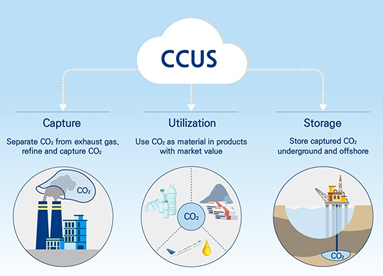
- Captured carbon dioxide can be converted into useful products, such as fuels, chemicals and building materials, or stored permanently in suitable underground geological formations.
- CCUS complements renewable energy expansion by addressing emissions from industrial processes that cannot be easily decarbonised through electrification alone.
- According to NITI Aayog, CCUS is important for decarbonising hard-to-abate sectors such as steel, cement, oil and gas, petrochemicals, chemicals and fertilisers.
Importance of CCUS for India
1. Decarbonisation of Hard-to-Abate Sectors
- CCUS reduces emissions from industries such as steel, cement, refineries, chemicals and fertilisers, where electrification alone is insufficient.
- Emissions from these sectors and thermal power generation may reach 2,300 million tonnes per annum by 2030.
2. Supporting India’s Net Zero Target
- Supports India’s Net Zero target by 2070 by reducing emissions that are difficult to eliminate through conventional clean-energy technologies.
- Complements renewable energy and enables lower-carbon industrial growth.
3. Enabling a Low-Carbon Hydrogen Economy
- CCUS enables blue hydrogen production by capturing emissions from fossil-fuel-based processes, including coal gasification.
- Green Hydrogen: Produced using renewable electricity to electrolyse water.
- Blue Hydrogen: Produced from fossil fuels with carbon capture.
4. Carbon Utilisation and Circular Economy
- Captured carbon dioxide can serve as a feedstock for several industrial applications, including:
- Concrete and building materials.
- Synthetic fuels, green methanol and chemicals.
- Polymers and urea.
- Algae-based products and biofuels.
- Products associated with enhanced oil recovery.
5. Sustaining Existing Energy Infrastructure
- As of August 2026, fossil fuels accounted for 45.12% of India’s installed power capacity.
- CCUS can reduce emissions from existing thermal power plants and industrial facilities, supporting India’s transition to cleaner energy.
CCUS Hubs and Clusters Model
- Regional hubs and clusters connect multiple emitters with shared infrastructure for CO₂ transport, utilisation and storage.
- NITI Aayog identifies this approach as suitable for India. It creates economies of scale, reduces infrastructure risk and links CO₂ supply with demand.
- DST’s CCUS Roadmap 2025 identifies potential cluster regions:
- Gujarat coast: refineries and chemical industries.
- Odisha–Jharkhand belt: steel and cement industries.
- Northeast India: oil and gas resources.
Important CCUS Projects and Developments in India
1. India’s First Integrated CCUS Field Laboratory
- Inaugurated at IIT Bombay in May 2026.
- Integrates carbon capture, utilisation and permanent geological storage on a single pilot-scale platform.
- The facility can capture up to 3 tonnes of CO₂ per day from industrial emissions and ambient air.
- It uses non-potable water and converts captured CO₂ into carbonate and bicarbonate products.
2. CCU Testbeds in Coal-Gasification Facilities
- DST has supported two technology-deployment testbeds for pilot-scale demonstrations in coal-gasification plants.
- The collaborations involve:
- IIT Delhi – Thermax Ltd
- CSIR-IICT Hyderabad – BHEL
- The projects focus on demonstrating carbon capture and utilisation technologies for producing methanol and dimethyl ether (DME).
3. CCU Projects Across India
- Operational: Three projects, located in Madhya Pradesh, Tamil Nadu and Maharashtra.
- Under Construction/Execution: Six projects, with three in Andhra Pradesh, two in Telangana and one in Maharashtra.
Conclusion
Carbon Capture, Utilisation and Storage is an important complementary technology in India’s transition towards a low-carbon economy. By capturing emissions from hard-to-abate sectors, converting CO₂ into useful products and enabling secure geological storage, CCUS can contribute to industrial decarbonisation and India’s Net Zero vision by 2070. Its success will depend on technological innovation, cost reduction, suitable infrastructure, effective monitoring and strong collaboration among government, industry and research institutions.
| Important CTC from this Article: Geological Storage |