
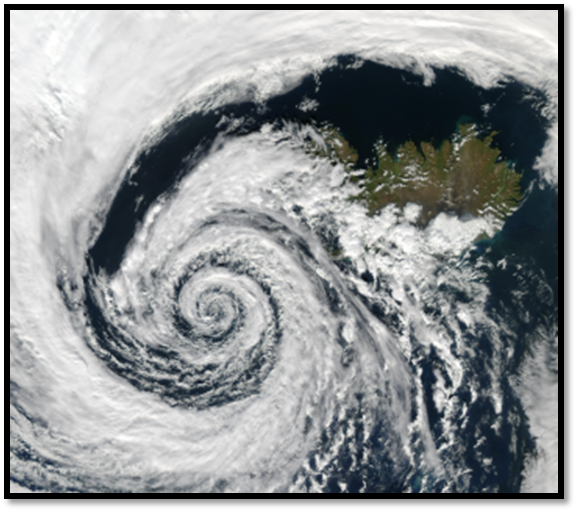
Context
Recently, the India Meteorological Department (IMD) issued alerts in several districts of Andhra Pradesh as Cyclone Murasu approached the coast, with the possibility of heavy to extremely heavy rainfall, strong winds and storm surges.
About Cyclone Murasu
· Cyclone Murasu was classified as a Severe Cyclonic Storm (SCS) that developed over the Westcentral and adjoining Southwest Bay of Bengal during the active Northeast Monsoon season.
· According to the IMD classification, a Severe Cyclonic Storm has sustained surface wind speeds of 48–63 knots (89–117 kmph) and may be accompanied by strong winds, storm surges and heavy to extremely heavy rainfall.
About Naming Convention of Cyclone
- Contributing Country: The name Murasu was contributed by India under the tropical cyclone naming system adopted by the WMO/ESCAP Panel on Tropical Cyclones (PTC) in 2020.
- Meaning: The term Murasu is derived from Tamil and refers to a traditional war drum or percussion instrument.
- Naming Sequence: It followed Cyclone Arnab, contributed by Bangladesh, in the naming list and is followed by Akvan, contributed by Iran.
About IMD Cyclone Warning System
- The India Meteorological Department (IMD) follows a four-stage colour-coded warning system to communicate the severity of approaching cyclones and facilitate timely preparedness and response.
- Pre-Cyclone Watch: Issued at least 72 hours in advance to indicate the possibility of adverse weather associated with an evolving cyclonic system.
- Cyclone Alert (Yellow): Issued at least 48 hours before the expected onset of adverse weather, advising authorities and the public to remain updated and vigilant.
- Cyclone Warning (Orange): Issued at least 24 hours in advance, providing information on the expected landfall, wind intensity, potential damage and storm surges to facilitate preparedness measures.
- Post-Landfall Outlook / Landfall Alert (Red): Issued at least 12 hours before the anticipated landfall, indicating a high level of danger and the need for immediate protective and emergency response measures.
| Important CTC From this article: Tropical Cyclone |
Q.  With reference to the naming of tropical cyclones in the North Indian Ocean, consider the following statements:

1. The naming of tropical cyclones is undertaken under the WMO/ESCAP Panel on Tropical Cyclones.
2. India is one of the countries contributing names to the regional cyclone naming list.
3. The India Meteorological Department functions as the Regional Specialised Meteorological Centre for the North Indian Ocean.
4. Each cyclone is named by the country over which it makes landfall.

Which of the statements given above are correct?

(a) 1, 2 and 3 only
(b) 1 and 4 only
(c) 2, 3 and 4 only
(d) 1, 2, 3 and 4

Answer: (a) 1, 2 and 3 only

Explanation:
• Statement 1 is correct: Cyclone naming in the North Indian Ocean region is undertaken through the WMO/ESCAP Panel on Tropical Cyclones.
• Statement 2 is correct: India is among the countries that contribute names to the regional list.
• Statement 3 is correct: IMD, New Delhi, functions as the Regional Specialised Meteorological Centre (RSMC) responsible for tropical cyclone advisories in the North Indian Ocean.
• Statement 4 is incorrect: Cyclone names are selected from a pre-approved regional list contributed by member countries. The country experiencing landfall does not determine the cyclone's name.