
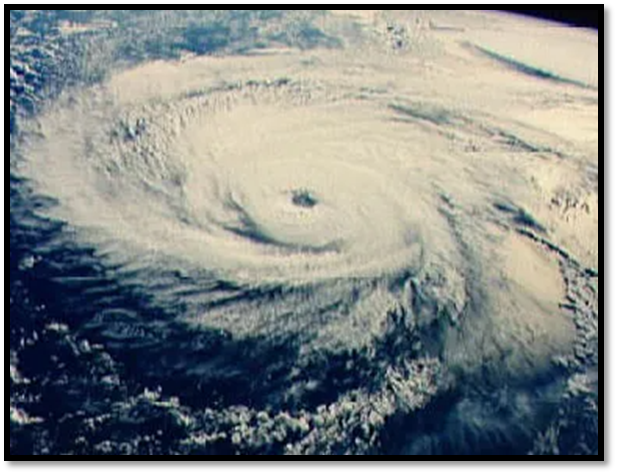
About Tropical Cyclones
- A Tropical Cyclone is an intense, rotating low-pressure weather system that develops over warm tropical oceans.
- It is characterised by strong winds, heavy rainfall, thunderstorms and a well-defined circulation around a central low-pressure area.
- Tropical cyclones generally develop over oceans with sea-surface temperatures of around 26.5°C or higher.
- They are powered by the release of latent heat through the condensation of water vapour.
- They generally form between 5° and 30° latitude in both hemispheres.
- The Coriolis force provides the rotation necessary for cyclone development; therefore, tropical cyclones rarely form close to the Equator.
- They rotate anticlockwise in the Northern Hemisphere and clockwise in the Southern Hemisphere.
Favourable Conditions for the Formation of Tropical Cyclones
- Warm Ocean Waters: Sea-surface temperatures of approximately 26.5°C or above provide energy and moisture.
- Atmospheric Instability: Promotes the development of deep convective clouds and thunderstorms.
- High Humidity: Adequate moisture in the middle troposphere supports sustained cloud formation.
- Coriolis Force: Provides the initial rotation required for the development of a cyclonic circulation.
- Low Vertical Wind Shear: Allows the cyclone’s vertical structure to remain organised.
- Pre-existing Low-Pressure Disturbance: Acts as the initial centre around which the cyclone develops.
- Upper-Level Outflow: Helps remove air from the upper part of the developing cyclone, supporting the maintenance of low pressure near the surface.
Structure of a Tropical Cyclone
- Eye: The central region of the cyclone, characterised by relatively calm weather, low pressure and comparatively clear skies.
- Eyewall: A ring of intense thunderstorms surrounding the eye, where the strongest winds and heaviest rainfall generally occur.
- Spiral Rainbands: Bands of clouds and thunderstorms extending outward from the centre, producing heavy rainfall and strong gusty winds.
Stages of Development of Tropical Cyclones
- Tropical Disturbance: Development of an organised area of thunderstorms over warm ocean waters.
- Tropical Depression: A low-pressure system develops with a more organised cyclonic circulation.
- Tropical Storm: Wind speed increases and the system becomes more organised.
- Mature Stage: The cyclone reaches its maximum intensity, with a well-developed eye and eyewall.
- Dissipation Stage: The cyclone weakens after moving over land, cooler waters or experiencing unfavourable atmospheric conditions.
Classification of Tropical Cyclones
Tropical cyclones are classified differently across ocean basins.
| Ocean Basin | Regional Name |
| North Atlantic Ocean | Hurricanes |
| Eastern and Central North Pacific | Hurricanes |
| Western North Pacific | Typhoons |
| Indian Ocean | Cyclones |
| South Pacific and South Indian Ocean | Tropical Cyclones |
Classification of Cyclones in the North Indian Ocean
According to the India Meteorological Department (IMD), tropical disturbances are classified based on maximum sustained surface wind speed.
| Category | Wind Speed (km/h) |
| Depression | 31–49 |
| Deep Depression | 50–61 |
| Cyclonic Storm | 62–88 |
| Severe Cyclonic Storm | 89–117 |
| Very Severe Cyclonic Storm | 118–166 |
| Extremely Severe Cyclonic Storm | 167–221 |
| Super Cyclonic Storm | 222 or more |
Naming of Tropical Cyclones
- Tropical cyclones are named to facilitate easy identification, communication and public awareness.
- In the North Indian Ocean, the naming system is coordinated by the World Meteorological Organization (WMO)/United Nations Economic and Social Commission for Asia and the Pacific (UNESCAP) Panel on Tropical Cyclones.
- The panel comprises 13 member countries, including India, Bangladesh, Myanmar, Pakistan, Sri Lanka, Thailand, Maldives, Oman, Iran, Qatar, Saudi Arabia, the UAE and Yemen.
- Each member country contributes a list of names, which are used sequentially when new cyclones develop.
- The IMD assigns names to tropical cyclones forming over the Bay of Bengal and the Arabian Sea.
Conclusion
Tropical cyclones are among the most destructive natural hazards affecting tropical and subtropical coastal regions. Understanding their formation, structure, classification and movement is essential for effective forecasting, early-warning systems and disaster risk reduction.
| This concept has been mentioned in the following article: Cyclone Murasu |