
About Ultraluminous X-ray Sources (ULXs)
- ULXs are extremely bright extragalactic X-ray sources found outside the central regions of galaxies.
- They emit X-rays with luminosities generally exceeding 10³⁹ erg/s.
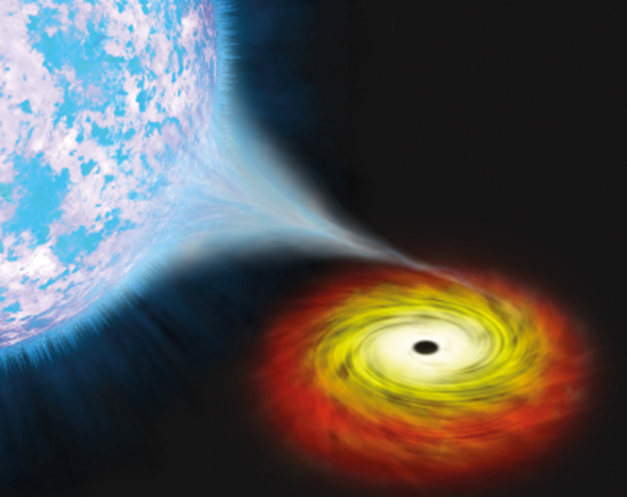
- They are believed to be powered by compact objects, primarily neutron stars or black holes, that attract matter from companion stars.
- As matter falls towards these compact objects, it gets heated to extremely high temperatures and releases intense X-ray radiation.
- Their luminosity can exceed the theoretical Eddington limit, making them important objects for studying extreme accretion processes.
Key Characteristics of ULXs
- Extreme Brightness: Their X-ray luminosity is generally greater than 10³⁹ erg/s, making them among the brightest X-ray sources outside galactic centres.
- Compact Objects: They are powered by accreting neutron stars or black holes.
- Accretion Process: Matter drawn from a companion star forms an accretion disc, heats up and emits intense X-rays.
- Super-Eddington Accretion: Some ULXs accrete matter at rates exceeding the classical Eddington limit.
- Extragalactic Location: They are generally found outside the central regions of galaxies.
- Strong Magnetic Fields: In neutron-star ULXs, extremely strong magnetic fields may help explain their unusually high luminosity.
What is the Eddington Limit?
- The Eddington Limit is the maximum luminosity at which the outward pressure of radiation balances the inward gravitational pull on matter.
- Beyond this limit, radiation pressure can potentially push away the surrounding matter and restrict further accretion under simplified assumptions.
- ULXs are important because some appear to exceed this theoretical limit, indicating the possibility of super-Eddington accretion.
Types of Compact Objects Powering ULXs
| Compact Object | Description |
| Neutron Stars | Extremely dense remnants of massive stars that have undergone gravitational collapse. |
| Stellar-Mass Black Holes | Black holes formed from the collapse of massive stars. |
| Intermediate-Mass Black Holes | Proposed as possible engines of some ULXs, although their presence remains uncertain. |
Important Space Observatories Used to Study ULXs
- Chandra X-ray Observatory (NASA): Detects and studies X-ray sources in distant galaxies.
- XMM-Newton (ESA): Studies the spectral properties and variability of X-ray sources.
- NuSTAR (NASA): Observes high-energy X-rays and helps investigate extreme accretion processes.
- Swift (NASA): Monitors variable astronomical sources across multiple wavelengths.
Conclusion
Ultraluminous X-ray Sources provide important insights into black holes, neutron stars and extreme accretion processes. Their study helps scientists understand how compact objects grow, release enormous amounts of energy and influence their surrounding galactic environments.
| This concept has been mentioned in the following article: Ultraluminous X-ray Sources (ULXs) |