
Context
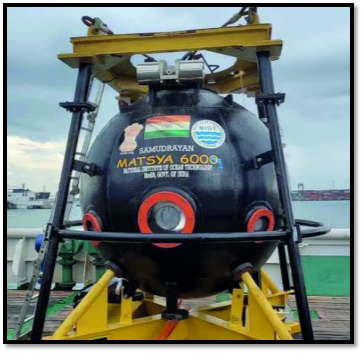
Recently, the Ministry of Earth Sciences has officially announced that the inaugural 500-metre trial dive of the Matsya-6000 submersible is scheduled for early 2027 in the Bay of Bengal.
Technical Specifications of Matsya-6000?
- Type: Manned deep-sea scientific submersible.
- Project: Samudrayaan, under the Deep Ocean Mission (DOM).
- Developer: National Institute of Ocean Technology (NIOT), Chennai.
- Ministry: Ministry of Earth Sciences.
- Capacity: Designed to carry three aquanauts to a depth of 6,000 metres.
- Hull: 2.1-metre-diameter spherical titanium-alloy structure.
- Endurance: 12–16 hours of normal operation and up to 96 hours in emergencies.
Institutional Collaboration and Execution
- Administrative Authority: Implemented under the overarching purview of the Ministry of Earth Sciences (MoES) as part of the ₹4,077 crore Deep Ocean Mission.
- Nodal Development: The National Institute of Ocean Technology (NIOT), Chennai, is the primary agency spearheading the submersible’s design and conceptualization.
- Space-Ocean Synergy: The Indian Space Research Organisation (ISRO) is collaborating directly on the fabrication and structural integration of the highly specialized titanium hull.
- Operational Readiness: Designated pilots (aquanauts) are currently undergoing rigorous specialized training ahead of the phased shallow-water trials.
Main Objectives of the Mission
- Pioneering Exploration: This represents India’s absolute first crewed mission dedicated to studying deep-ocean mineral resources and conducting comprehensive biodiversity assessments.
- Ecological Safeguards: The submersible is utilized strictly for non-destructive observation and exploration, ensuring that fragile benthic ecosystems remain entirely undisturbed.
- Policy Convergence: The initiative acts as a foundational operational pillar for the Deep Ocean Mission, directly propelling the Central Government’s broader Blue Economy mandate.
| Samudrayaan Project: Exploring the Deep Ocean: • Launched: 2021, under the Deep Ocean Mission (DOM). • Nodal Ministry: Ministry of Earth Sciences. • Implementing Agency: National Institute of Ocean Technology (NIOT), Chennai. • Objective: Develop indigenous technology for manned deep-sea exploration. • Key Component: Matsya-6000, a manned submersible designed to carry three aquanauts to a depth of 6,000 metres. • Major Focus Areas: o Exploration of deep-sea biodiversity and marine ecosystems. o Assessment of polymetallic nodules and other deep-sea minerals. o Advancement of indigenous underwater technologies. • Significance: Enhance India’s scientific, technological and strategic capabilities in deep-ocean exploration. |
| Important CTC from this Article: Deep Ocean Mission |
Q. Which of the following statements with regard to India's Deep Ocean Mission is/are correct?

1. It was launched by the Ministry of Ports, Shipping and Waterways, Government of India.
2. Matsya-6000 has been designed to carry 3 people for deep sea exploration.
3. Samudrayaan is a project under this mission.

Select the answer using the code given below:
(a) 1 only
(b) 2 and 3 only
(c) 1 and 2 only
(d) 1, 2 and 3


                                         Sample MCQ

Q. Consider the following statements regarding the Samudrayaan Mission and Matsya-6000:

1. The Samudrayaan Mission is executed under the administrative purview of the Ministry of Earth Sciences.
2. The Matsya-6000 submersible features a titanium alloy personnel sphere designed exclusively by the National Institute of Ocean Technology without any external collaboration.
3. The submersible is engineered to sustain a maximum continuous operational endurance of 96 hours under standard conditions.

Which of the statements given above is/are correct?

(a) 1 only
(b) 1 and 2 only
(c) 2 and 3 only
(d) 1, 2 and 3

Answer: (a) 1 only

Explanation:
• Statement 1 is correct: The Samudrayaan Mission is implemented by the Ministry of Earth Sciences (MoES), with NIOT acting as the primary nodal agency.
• Statement 2 is incorrect: While NIOT is developing the overall submersible, the highly specialized 2.1-metre titanium alloy personnel sphere is being constructed in direct collaboration with the Indian Space Research Organisation (ISRO).
• Statement 3 is incorrect: The submersible is designed for a standard continuous operational endurance of 12 hours. The 96-hour capacity is strictly reserved for emergency life-support scenarios.